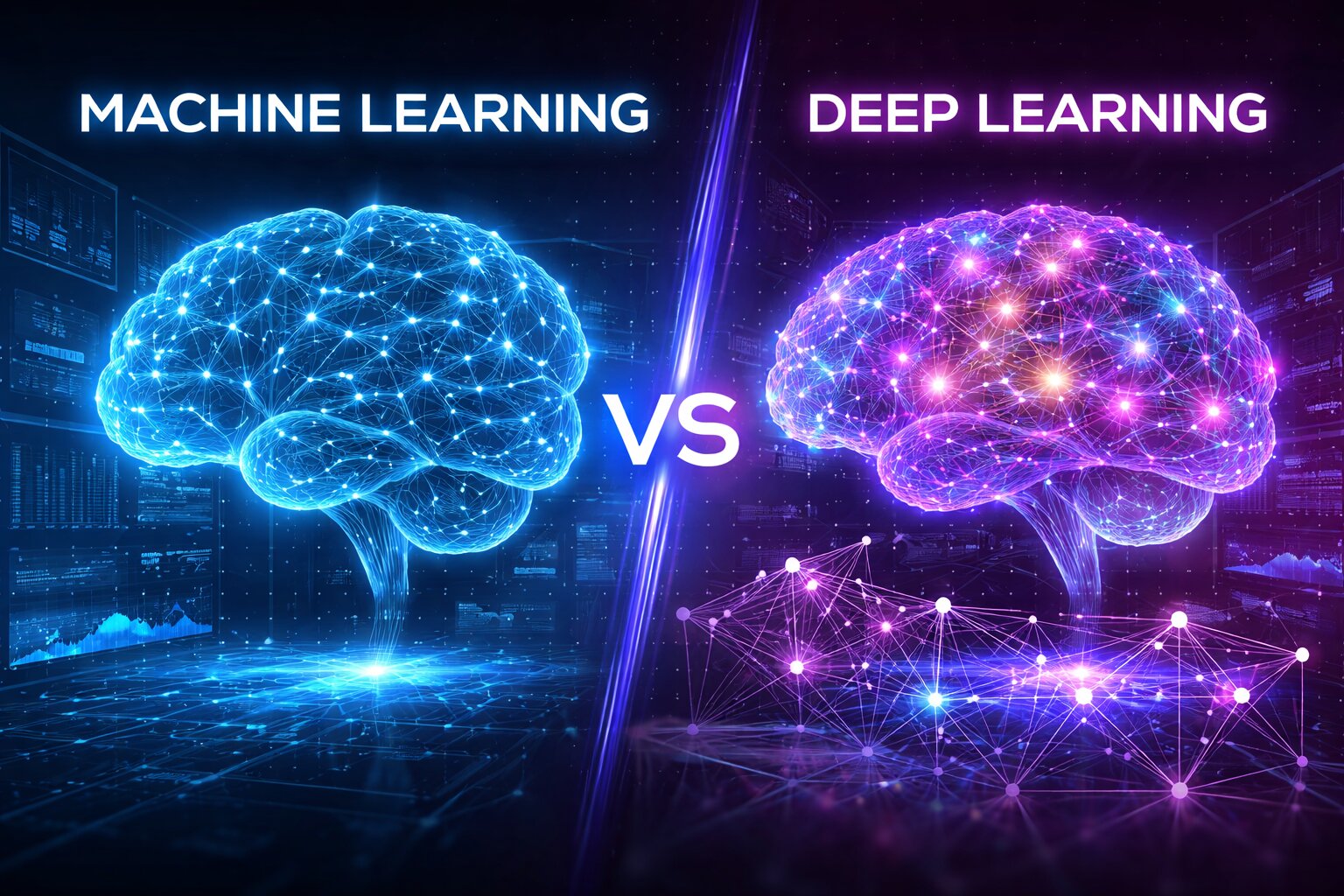
Machine Learning vs Deep Learning: What’s the Difference and Why It Matters
Introduction
Artificial intelligence has rapidly moved from a niche area of research into a central force shaping modern technology. From recommendation engines and voice assistants to fraud detection systems and autonomous vehicles, AI-driven systems are now embedded in everyday life. Within this broad field, two terms are frequently used—machine learning and deep learning. While often used interchangeably in popular discussions, they represent distinct approaches with different capabilities, requirements, and implications.
Understanding the difference between machine learning and deep learning is increasingly important, not only for those working in technology but also for businesses, policymakers, and general readers seeking to make sense of how intelligent systems operate. Both play a crucial role in enabling modern AI, but they differ significantly in how they process data, learn patterns, and scale across complex problems.
This article explores what machine learning and deep learning are, how they differ, where each is used, and why the distinction matters as technology continues to evolve as we consider the future of artificial intelligence.
What Is Machine Learning?
Machine learning is a subset of artificial intelligence that focuses on building systems capable of learning from data rather than relying on explicitly programmed instructions. Instead of writing code that specifies every possible scenario, developers train machine large language learning models on datasets, allowing the system to identify patterns and make predictions or decisions.
At its core, machine learning involves feeding data into algorithms that improve their performance over time. These algorithms can be broadly categorised into three main types: supervised learning, unsupervised learning, and reinforcement learning.
In supervised learning, models are trained using labelled data, meaning that each input is paired with a known output. For example, an email filtering system might be trained on a dataset where messages are labelled as “spam” or “not spam.” Over time, the model learns to classify new emails based on these patterns.
Unsupervised learning, by contrast, deals with unlabelled data. The goal is to uncover hidden structures or relationships within the dataset. This approach is often used in clustering and anomaly detection, where the system identifies patterns without predefined categories.
Reinforcement learning takes a different approach, where an agent learns by interacting with an environment and receiving feedback in the form of rewards or penalties. This method is commonly used in robotics, gaming, and optimisation problems.
Machine learning models typically rely on structured data and require feature engineering, a process where developers manually select and transform input variables to improve model performance. This step is crucial and often determines how effective a machine learning system will be.
What Is Deep Learning?
Deep learning is a specialised subset of machine learning that uses neural networks with multiple layers—often referred to as deep neural networks—to model complex patterns in data. Inspired loosely by the structure of the human brain, these networks consist of interconnected nodes (neurons) organised in layers.
What distinguishes deep learning from traditional machine learning is its ability to automatically learn representations from raw data. Instead of requiring manual feature engineering, deep learning models can process unstructured data such as images, audio, and text, extracting meaningful features on their own.
For example, in image recognition, a deep learning model can identify edges, shapes, and objects through successive layers of processing. Early layers might detect simple patterns like lines or colours, while deeper layers combine these into more complex representations such as faces or objects.
Deep learning has been particularly successful in areas such as natural language processing, computer vision, and speech recognition. Technologies like virtual assistants, real-time translation, and generative AI systems are powered largely by deep learning techniques.
However, these capabilities come with trade-offs. Deep learning models typically require significantly more data and computational power than traditional machine learning models. Training such systems often involves specialised hardware such as GPUs or dedicated AI chips.
Key Differences Between Machine Learning and Deep Learning
While deep learning is technically a subset of machine learning, the differences between the two are substantial in practice. One of the most important distinctions lies in how they handle data.
Machine learning models generally perform well with structured data and smaller datasets. They rely on human expertise to define features and guide the learning process. This makes them more accessible and easier to interpret but can limit their ability to handle complex or unstructured inputs.
Deep learning models, on the other hand, excel at processing large volumes of unstructured data. They automatically extract features through layered architectures, reducing the need for manual intervention. This allows them to achieve higher accuracy in tasks such as image recognition or language understanding.
Another key difference is computational demand. Machine learning models can often be trained on standard hardware and require less processing power. Deep learning models, by contrast, are resource-intensive and may require advanced infrastructure, particularly when dealing with large-scale datasets.
Interpretability is also an important factor. Machine learning models are generally easier to understand and explain, making them more suitable for applications where transparency is critical, such as finance or healthcare decision-making. Deep learning models are often described as “black boxes,” where it can be difficult to trace how specific decisions are made.
Finally, the development process differs significantly. Machine learning involves more manual tuning and feature engineering, while deep learning shifts much of that complexity into the model architecture itself. This can simplify development in some cases but also introduces challenges related to training, optimisation, and debugging.
Real-World Applications
Both machine learning and deep learning are widely used across industries, often complementing each other depending on the problem being solved.
Machine learning is commonly used in applications such as recommendation systems, predictive analytics, fraud detection, and customer segmentation. For example, e-commerce platforms use machine learning algorithms to recommend products based on user behaviour, while financial institutions rely on them to identify unusual transaction patterns.
Deep learning, meanwhile, is driving advances in areas that require processing complex or unstructured data. In healthcare, deep learning models are used to analyse medical images, assisting in the detection of diseases such as cancer. In the automotive industry, they play a key role in enabling autonomous driving systems by interpreting sensor data in real time.
Natural language processing is another area where deep learning has had a significant impact. Language models can generate text, translate languages, and understand context at a level that was not possible with earlier machine learning techniques.
In many cases, organisations use a combination of both approaches. Machine learning may be used for structured data tasks, while deep learning is applied to more complex inputs, creating hybrid systems that leverage the strengths of each method.
Why the Distinction Matters
Understanding the difference between machine learning and deep learning is not just a technical detail; it has practical implications for how organisations adopt and deploy AI technologies.
From a business perspective, choosing between machine learning and deep learning depends on factors such as data availability, computational resources, and the nature of the problem. Not every task requires deep learning, and in some cases, traditional machine learning models may offer a more efficient and cost-effective solution.
For developers and engineers, the distinction influences how systems are designed, trained, and maintained. Deep learning projects often involve longer development cycles, more complex infrastructure, and ongoing optimisation to achieve desired performance levels.
There are also broader implications for ethics and regulation. Deep learning models, due to their complexity, can be more difficult to audit and explain. This raises concerns around accountability, bias, and transparency, particularly in high-stakes applications such as hiring, lending, or healthcare.
From an educational standpoint, understanding these differences helps demystify AI and provides a clearer picture of how intelligent systems function. As AI becomes more integrated into society, this knowledge becomes increasingly valuable for informed decision-making.
Challenges and Limitations
Despite their capabilities, both machine learning and deep learning face significant challenges.
Machine learning models can struggle with complex data and may require extensive feature engineering to achieve high accuracy. They are also sensitive to data quality, meaning that poor or biased datasets can lead to unreliable outcomes.
Deep learning models, while powerful, are not without limitations. Their reliance on large datasets can be a barrier, particularly in domains where data is scarce or expensive to obtain. They also require substantial computational resources, which can increase costs and limit accessibility.
Another concern is interpretability. As deep learning models become more complex, understanding how they arrive at decisions becomes increasingly difficult. This lack of transparency can be problematic in regulated industries or situations where trust is essential.
Additionally, both approaches are susceptible to bias. If training data reflects existing inequalities or inaccuracies, the resulting models may reinforce those patterns. Addressing these issues requires careful data selection, testing, and ongoing monitoring.
The Future of Machine Learning and Deep Learning
As AI continues to evolve, the relationship between machine learning and deep learning is likely to become even more interconnected. Advances in hardware, data availability, and algorithm design are enabling increasingly sophisticated models that combine elements of both approaches.
One emerging trend is the development of more efficient deep learning models that require less data and computational power. Techniques such as transfer learning and model compression are making it possible to apply deep learning in a wider range of contexts.
At the same time, there is growing interest in improving the interpretability and transparency of generative AI systems. Researchers are exploring methods to make deep learning models more explainable, bridging the gap between performance and accountability.
Another important development is the integration of AI into everyday tools and platforms. As machine learning and deep learning become more accessible, they are being embedded into software applications, enabling new forms of automation and decision-making.
Ultimately, both machine learning and deep learning will continue to play a central role in shaping the future of technology. Rather than competing approaches, they represent complementary tools that can be applied in different contexts to solve a wide range of problems.
Conclusion
Machine learning and deep learning are closely related but fundamentally different approaches within the broader field of artificial intelligence. Machine learning provides a flexible and accessible framework for analysing structured data and making predictions, while deep learning extends these capabilities to more complex and unstructured domains.
The choice between the two depends on the specific requirements of a task, including the type of data, available resources, and desired outcomes. Understanding their differences helps organisations make more informed decisions and enables individuals to better grasp the technologies shaping the modern digital landscape.
As AI continues to advance, both machine learning and deep learning will remain essential components of innovation. By recognising their strengths, limitations, and applications, it becomes possible to navigate the evolving world of intelligent systems with greater clarity and confidence.
Ethical concerns around AI are also likely to grow and we’ll keep reporting on the key issues here at Dykes Do Digital.