
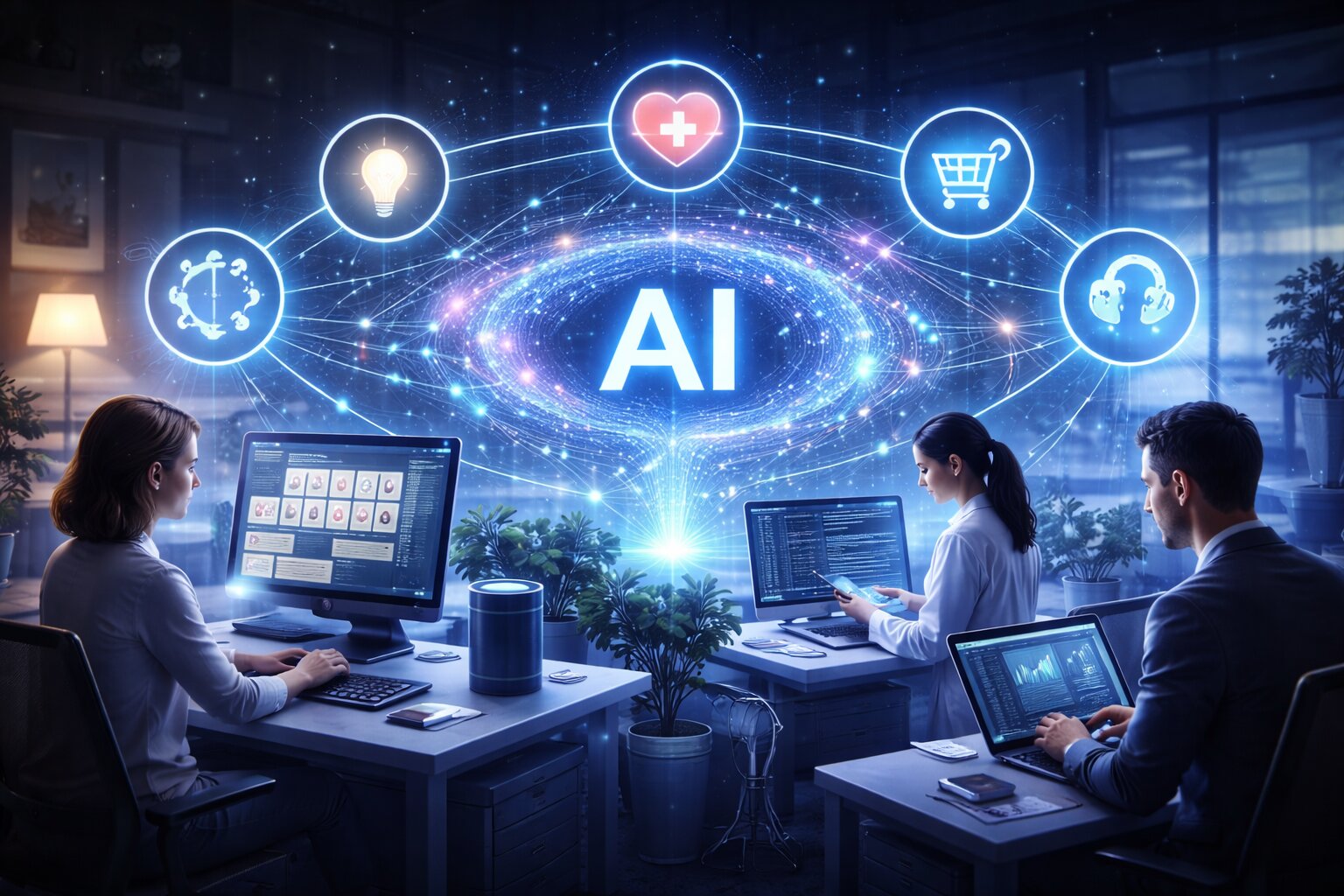
Generative AI Adoption Trends Across Industries
Generative artificial intelligence has moved rapidly from experimental technology to a central force shaping how organisations operate. Once limited to research environments and niche applications, generative AI is now being integrated into workflows across industries, influencing how content is created, how decisions are made, and how services are delivered.
This shift is not driven by a single innovation, but by a combination of advances in large language models, image generation systems, and multimodal AI capabilities. As these technologies become more accessible, businesses are exploring how they can be applied to improve efficiency, reduce costs, and create new forms of value.
Understanding how generative AI is being adopted across industries provides insight into both its current impact and its longer-term implications.
From Experimentation to Integration
The early stages of generative AI adoption were characterised by experimentation. Organisations tested the capabilities of AI systems, often in isolated projects or pilot programmes.
In recent years, this has shifted toward integration. Generative AI is increasingly being embedded into existing tools and workflows, becoming part of everyday operations rather than a standalone innovation.
This transition reflects growing confidence in the technology, as well as a better understanding of its strengths and limitations.
Integration also allows organisations to scale their use of AI, applying it across multiple functions and departments.
Content Creation and Media
One of the most visible areas of generative AI adoption is in content creation. AI systems can generate text, images, video, and audio, enabling new approaches to media production.
In marketing and communications, generative AI is used to create written content, design visuals, and personalise messaging. This can significantly reduce the time and resources required to produce content at scale.
Media organisations are also exploring how AI can support journalism, from drafting articles to summarising information.
While these applications offer efficiency gains, they also raise questions about originality, authorship, and the role of human creativity. There’s a whole wave of questions surrounding the impact of AI upon social media, of course.
Software Development and Engineering
Generative AI is having a significant impact on software development. AI-powered tools can assist with code generation, debugging, and documentation, improving productivity and reducing development time.
Developers can use natural language prompts to generate code snippets, automate repetitive tasks, and explore new approaches more quickly.
This is changing how software is created, shifting some aspects of development from manual coding to AI-assisted workflows.
At the same time, it requires new skills, as developers must understand how to work effectively with AI systems and evaluate their outputs.
Customer Service and Support
Customer service is another area where generative AI is being widely adopted. AI-powered chatbots and virtual assistants can handle a range of customer interactions, from answering questions to resolving issues.
These systems can operate continuously, providing support at any time and reducing the need for human intervention in routine cases.
Generative AI enables more natural and context-aware interactions, improving the user experience compared to earlier rule-based systems.
However, maintaining quality and ensuring that complex or sensitive issues are handled appropriately remains an important consideration.
Healthcare and Life Sciences
In healthcare, generative AI is being explored for applications such as medical documentation, research support, and drug discovery.
AI systems can assist in summarising patient records, generating reports, and analysing research data. This can reduce administrative burden and support clinical decision-making.
In drug discovery, generative models can be used to design new molecular structures and predict their properties, potentially accelerating the development of new treatments.
While these applications are promising, they also require careful validation to ensure accuracy and safety.
We’ve separately covered, in some detail, healthcare applications of AI. There’s something here that does cause concern among many employees too, which we also acknowledge: is your job safe from the impact of AI?
Finance and Business Operations
Financial institutions are adopting generative AI for tasks such as report generation, risk analysis, and customer communication.
AI can analyse large datasets to generate insights and produce summaries, supporting decision-making processes.
In business operations, generative AI is being used to automate documentation, streamline workflows, and improve internal communication.
These applications can enhance efficiency and reduce costs, but they also require robust governance to manage risks.
Education and Learning
In education, generative AI is being used to create learning materials, provide tutoring support, and personalise educational experiences.
AI-generated content can be tailored to different learning levels and styles, supporting more adaptive learning environments.
Educators are also using AI to assist with grading and feedback, reducing administrative workload.
At the same time, there are concerns about academic integrity and the potential for misuse, highlighting the need for clear guidelines and policies.
Design, Creativity, and Innovation
Generative AI is expanding the possibilities of design and creativity. Designers can use AI tools to generate concepts, explore variations, and accelerate the creative process.
This can lead to more rapid innovation, as ideas can be tested and refined more quickly.
In industries such as fashion, architecture, and product design, generative AI is being used to explore new forms and approaches.
While AI can support creativity, it also raises questions about authorship and the role of human input in the creative process.
Challenges in Adoption
Despite its rapid adoption, generative AI presents several challenges.
One of the main concerns is accuracy. AI-generated outputs may contain errors or inconsistencies, requiring human oversight.
There are also issues related to bias, as models trained on existing data may reflect underlying biases present in that data.
Data privacy and security are additional considerations, particularly when sensitive information is involved.
Organisations must also consider the ethical implications of using generative AI, including transparency and accountability.
Regulation and Governance
As generative AI becomes more widespread, there is increasing focus on regulation and governance.
Governments and organisations are working to establish frameworks that address issues such as data usage, intellectual property, and accountability.
These frameworks aim to balance innovation with the need to manage risks and protect users.
The regulatory landscape is still evolving, and organisations must navigate uncertainty as they adopt new technologies.
The Future of Generative AI Adoption
The adoption of generative AI is likely to continue expanding as the technology matures. Advances in model capabilities, integration, and usability will enable new applications and use cases.
Multimodal systems, which can process and generate multiple types of data, are likely to play a key role in future developments.
At the same time, organisations will need to develop strategies for managing risks and ensuring responsible use.
A Transformative Force Across Industries
Generative AI is reshaping industries by changing how work is performed and how value is created. Its ability to generate content, analyse data, and support decision-making is driving new forms of efficiency and innovation.
At the same time, its adoption raises important questions about accuracy, ethics, and the role of human oversight.
As organisations continue to integrate generative AI into their operations, understanding these dynamics will be essential for navigating the opportunities and challenges that lie ahead.
Generative AI adoption is an interesting topic and one of many that we cover here at Dykes Do Digital. We’re always looking to expand our team of writers. If you’d like to write for us on technology issues, then we’d love to hear from you.