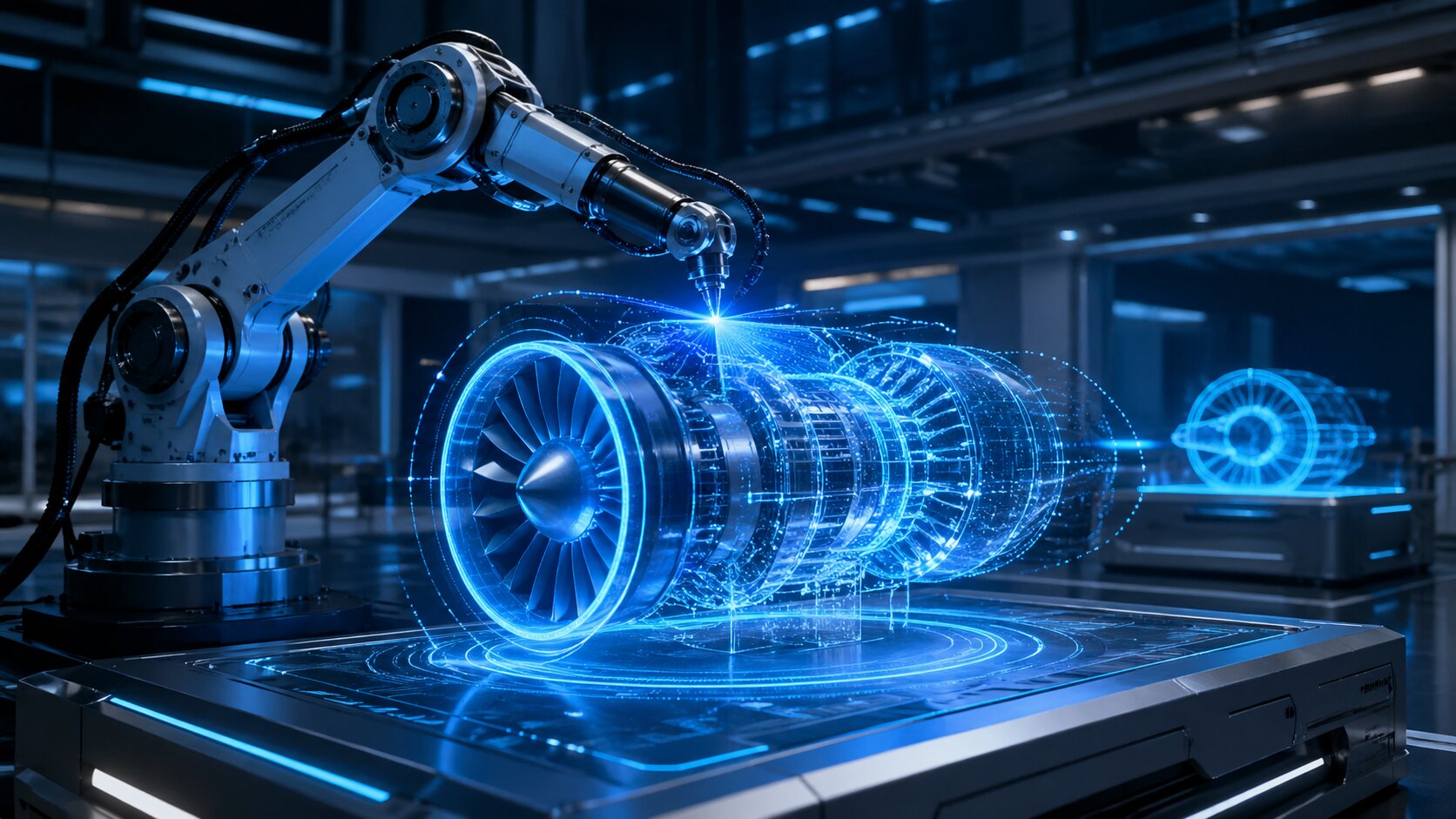
Engineering Applications of Artificial Intelligence
Artificial intelligence is becoming part of the engineering toolkit. It is not replacing the fundamentals of engineering, and it is not removing the need for judgement, testing or professional responsibility. But it is changing how engineers design, simulate, inspect, monitor and optimise the systems that modern life depends on.
Engineering has always involved working with constraints. A bridge must be strong enough, but not wasteful. A battery must store more energy, but remain safe and affordable. A manufacturing process must be fast, but precise. A power grid must be reliable, but increasingly flexible. A product must perform well, but also be manufacturable, maintainable and cost-effective.
AI is useful because many engineering problems now involve more variables, more data and more operational complexity than traditional methods can easily manage alone. Machine learning can identify patterns in sensor data. Computer vision can inspect components and infrastructure. Generative systems can propose design variations. Optimisation algorithms can test thousands of alternatives. Predictive models can warn that a machine, structure or network is drifting toward failure.
The important point is that engineering applications of artificial intelligence are not limited to one discipline. They appear in civil engineering, mechanical engineering, electrical engineering, aerospace, automotive design, energy systems, materials science, robotics, software engineering and industrial operations. In each case, AI is most valuable when it helps engineers make better decisions, not when it hides uncertainty behind a polished dashboard.
This is why the subject deserves careful treatment. AI can accelerate engineering work, but it can also introduce new risks. A model can be wrong. Data can be incomplete. Simulations can simplify reality too much. Automated systems can make recommendations that look confident but fail under unusual conditions. In engineering, where decisions can affect safety, cost, infrastructure and public trust, AI has to be used with discipline.
Why AI matters in engineering
Engineering is increasingly data-rich. Modern systems produce information constantly: vibration readings from bridges, temperature readings from industrial equipment, pressure data from pipelines, images from inspection drones, performance data from vehicles, telemetry from power systems and operational logs from factories.
That data can be too large, too fast-moving or too complex for manual analysis alone. AI systems are well suited to finding patterns in large datasets, especially when the goal is to detect anomalies, classify conditions, predict outcomes or optimise performance.
This is one reason applied AI has become a major technology trend across industries. McKinsey’s 2025 technology trends outlook grouped applied AI, generative AI, industrialised machine learning and next-generation software development under a wider artificial intelligence category, while also identifying agentic AI and application-specific semiconductors as newer areas of momentum. That broader shift matters for engineering because AI is no longer just a research tool; it is becoming part of mainstream industrial software, design workflows and operational decision-making.
The strongest engineering use cases usually have three characteristics. First, there is enough data to support analysis. Second, the task benefits from speed or scale. Third, the output can be checked against physical evidence, engineering rules or human expertise.
That final point is important. Engineering is not only prediction. It is also validation. AI can suggest, detect or optimise, but engineers still need to verify that the result is safe, practical and compliant with the real-world constraints of the system.
Generative design and product engineering
One of the most visible applications of AI in engineering is generative design. Instead of creating one design and testing it, engineers can define goals and constraints, then allow software to generate many possible options.
A design system might be asked to reduce weight, increase strength, improve airflow, minimise material use or fit within a manufacturing process. It can then explore a wide design space much faster than a human team could manually test every possibility.
This is especially useful in aerospace, automotive, product design and mechanical engineering, where small gains in weight, strength or efficiency can have large downstream effects. A lighter component may reduce fuel use. A more efficient structure may reduce material costs. A better thermal design may improve reliability.
Generative AI is also beginning to influence earlier stages of product development. McKinsey has noted that generative AI can help industrial designers explore more ideas and product experiences faster than traditional methods, while also warning that it is not a magic wand and still depends on human direction, evaluation and refinement.
That distinction is central. Generative design can produce surprising shapes and possibilities, but not every generated option is practical. A design must still be tested for manufacturability, durability, cost, repairability, sustainability and compliance. AI can widen the field of options; engineers still need to decide which options make sense.
Predictive maintenance and industrial systems
Predictive maintenance is one of the most practical engineering applications of artificial intelligence. It uses data from machines, sensors and operational systems to estimate when equipment is likely to fail or require servicing.
Traditional maintenance often follows a schedule. A machine is inspected every set number of hours, weeks or months. That can work, but it may lead to unnecessary maintenance if the equipment is healthy, or late maintenance if the machine deteriorates faster than expected.
Predictive maintenance aims to be more responsive. It looks for early warning signs: abnormal vibration, rising temperature, unusual sound, pressure changes, energy inefficiency or patterns in maintenance history. AI models can identify combinations of signals that may be difficult for humans to detect manually.
In manufacturing, this can reduce downtime and improve productivity. In transport, it can help maintain vehicles, rail systems and aircraft components. In energy, it can support turbines, substations, pumps and grid infrastructure. In heavy industry, it can help operators move from reactive repairs to condition-based maintenance.
The benefit is not only cost reduction. It is also reliability. A factory that avoids unexpected shutdowns can run more consistently. A utility that detects equipment stress early can improve service resilience. A transport operator that anticipates component issues can reduce disruption and safety risk.
The limitation is that predictive maintenance depends heavily on data quality. Sensors must be reliable. Historical records must be accurate. Models must be tested against real failures, not just idealised examples. An AI system that produces too many false alarms will be ignored. One that misses serious failures may create a false sense of security.
Structural health monitoring
Civil infrastructure is another area where AI has strong potential. Bridges, tunnels, dams, pipelines, towers and large buildings all need monitoring over long periods. Ageing infrastructure, climate stress, heavy usage and limited maintenance budgets make this increasingly important.
Structural health monitoring uses sensors, inspection data and analytical methods to understand the condition of infrastructure. AI can support this by detecting cracks, deformation, corrosion, vibration changes or other signs of damage.
Recent research on AI in structural health monitoring has described AI as a powerful tool for improving accuracy, robustness and operational efficiency, with early applications focused on vibration-based monitoring and automated data-driven damage detection. Another 2024 review argued that AI is having growing influence on infrastructure monitoring, including data acquisition, sensor networks and anomaly detection.
This is an area where the engineering value is easy to understand. Inspecting every part of a large structure manually is difficult and expensive. Drones, cameras, sensors and AI-assisted analysis can help engineers focus attention where it is most needed.
However, infrastructure safety cannot be handed over to algorithms without caution. A model trained on one type of structure may not perform well on another. Environmental conditions can affect sensor data. Visual inspection systems may struggle with lighting, weather, dirt or unusual materials. AI can help prioritise and interpret evidence, but professional engineering judgement remains essential.
AI in electrical and electronics engineering
Artificial intelligence in electrical engineering is becoming particularly important because modern electrical systems are more complex, decentralised and data-driven than they used to be.
Power systems now have to manage renewable energy, battery storage, electric vehicle charging, smart meters and changing demand patterns. AI can help forecast load, detect faults, optimise energy distribution and support grid stability. In electronics, AI can support circuit design, semiconductor inspection, signal processing, fault detection and embedded systems.
This is also where engineering links closely with edge AI. More devices are gaining local intelligence through sensors, microcontrollers and AI accelerators. Smart appliances, industrial controllers, medical devices, vehicles and energy systems increasingly need to process information close to where it is generated.
The electrical engineering angle matters because AI is not only software running somewhere in the cloud. It also depends on physical systems: chips, circuits, sensors, power electronics, communications networks and control systems. Without electrical and electronics engineering, many real-world AI applications would not be practical.
This is why the relationship between AI and electrical engineering deserves its own detailed treatment. It sits at the intersection of power, hardware, communications, automation and intelligent control.
Robotics and autonomous systems
Robotics is one of the most natural homes for AI in engineering. A robot needs to sense its environment, interpret data, make decisions and act physically. AI can support computer vision, path planning, object recognition, grasping, navigation, human-robot interaction and adaptive control.
In manufacturing, robots can inspect products, handle materials, support assembly and perform repetitive or hazardous tasks. In warehouses, they can move goods and coordinate with inventory systems. In agriculture, robotic systems can monitor crops, target spraying, analyse soil conditions or assist harvesting. In healthcare, robotics can support surgery, rehabilitation and logistics.
Autonomous vehicles and drones are more complex examples. They combine mechanical engineering, electrical engineering, software, sensors, communications, control systems and AI. Their challenge is not simply recognising objects; it is making safe decisions in changing, unpredictable environments.
The engineering difficulty is that the real world is messy. A robot may encounter unfamiliar objects, poor lighting, dust, rain, damaged surfaces, unpredictable humans or sensor failures. This is why testing, simulation, safety cases and fallback modes are so important.
AI can make robots more flexible, but flexibility must be constrained by safety. A robot that improvises without adequate limits is not an engineering success.
Simulation, digital twins and optimisation
AI is also changing how engineers simulate and optimise systems. Traditional simulation can be extremely powerful, but it can also be computationally expensive. Engineers may need to model fluid dynamics, thermal behaviour, structural stress, electromagnetic fields, traffic flows, energy systems or production lines.
AI can support simulation in several ways. It can help create faster surrogate models, identify the most important variables, guide optimisation, detect unusual simulation outputs or combine real-world data with simulated environments.
Digital twins are a related concept. A digital twin is a virtual representation of a physical system, updated with real-world data. In engineering, digital twins can be used to monitor equipment, test changes, predict performance and plan maintenance.
AI can make digital twins more useful by interpreting data, forecasting behaviour and recommending adjustments. A factory might use a digital twin to test production changes before applying them. A city might use one to model traffic, energy use or infrastructure stress. An energy company might use one to monitor turbines or grid assets.
The value lies in reducing uncertainty. Engineers can test scenarios before committing money, materials or operational risk. But digital twins are only as reliable as the data, assumptions and models behind them. A sophisticated visual interface does not guarantee that the underlying representation is accurate.
Materials engineering and discovery
Materials engineering is another area where AI is becoming important. Designing or discovering new materials can involve a huge number of possible combinations, structures and processing methods. AI can help narrow the search.
Machine learning can be used to predict material properties, identify promising compounds, optimise manufacturing conditions or analyse experimental data. This can support battery research, semiconductors, alloys, composites, polymers, catalysts and sustainable materials.
The attraction is clear. Better materials can improve almost every branch of engineering. Stronger composites can help aerospace and automotive design. Better batteries can support electric vehicles and grid storage. More efficient semiconductors can improve computing. More durable materials can extend infrastructure life.
AI does not remove the need for laboratory testing. A predicted material still has to be made, measured, stressed, aged and evaluated. But by guiding researchers toward more promising candidates, AI can reduce the time spent exploring unlikely options.
Engineering design reviews and documentation
Not every AI use case is dramatic. Some of the most useful applications may be administrative and analytical.
Engineering teams produce large amounts of documentation: specifications, drawings, test reports, compliance records, maintenance logs, risk assessments, procurement documents and change requests. AI can help search, summarise and compare this material.
A model might identify inconsistencies between a requirement and a test plan. It might extract key risks from a report. It might help engineers compare design revisions. It might support translation between technical teams and non-technical stakeholders.
This matters because engineering work is not only physical design. It is also communication, verification and traceability. Many failures begin not with a single bad calculation, but with unclear requirements, poor documentation, missed assumptions or weak handovers.
AI tools that improve engineering knowledge management could therefore have real value, provided they are used carefully. A summary must not become a substitute for reading the original document where safety or compliance is involved.
The risks of AI in engineering
Engineering applications of AI need stronger governance than many consumer AI tools. If an AI writing assistant makes a weak suggestion, the damage may be limited. If an AI-supported engineering system misclassifies a structural defect, underestimates a load, misses a fault or optimises for the wrong objective, the consequences can be serious.
The NIST AI Risk Management Framework was developed to help manage risks to individuals, organisations and society associated with AI. Its emphasis on governing, mapping, measuring and managing AI risk is relevant to engineering because AI systems need to be evaluated in context, not treated as abstract tools.
For engineering teams, this means asking practical questions. What data was the model trained on? Does it apply to this environment? How accurate is it under edge cases? What happens when sensors fail? How are recommendations logged? Who approves high-impact decisions? How is the model monitored after deployment?
Bias is also relevant, though it may appear differently than in consumer AI. A model trained on data from one geography, climate, machine type, material or operating pattern may not generalise elsewhere. Data gaps can become engineering blind spots.
Cybersecurity is another concern. AI-connected engineering systems may depend on sensors, networks, cloud platforms and operational technology. If those systems are compromised, attackers may manipulate data, disrupt operations or mislead decision-makers. Engineering AI has to be secured as part of the wider system.
How computing has transformed engineering
To understand the current AI shift, it helps to look at how computing has transformed engineering already.
Computer-aided design changed drafting. Simulation changed testing. Embedded software changed products. Sensors changed monitoring. Cloud platforms changed collaboration. Data analytics changed operations. Each wave did not remove engineering skill; it changed what engineers could see, calculate and control.
AI is the next stage in that pattern. It gives engineers new ways to work with complexity, but it also creates new dependencies. The engineer of the future may spend less time manually checking routine outputs and more time defining problems, validating models, interpreting uncertainty and making decisions across technical, ethical and economic constraints.
This does not make engineering less human. It may make human judgement more important. As tools become more capable, the responsibility for asking the right questions becomes more valuable.
What comes next for AI innovation in engineering
AI innovation in engineering is likely to move in several directions at once.
The first is deeper integration into existing engineering software. AI will become less of a separate tool and more of a feature built into design, simulation, monitoring and project-management platforms.
The second is more real-time decision support. As sensors, edge computing and AI chips improve, engineering systems will be able to analyse conditions locally and respond faster.
The third is more autonomous operation, especially in industrial systems, robotics and infrastructure monitoring. This will create efficiency gains, but it will also require clearer safety rules and stronger oversight.
The fourth is better human-machine collaboration. The most useful AI systems will not simply produce answers. They will explain assumptions, show uncertainty, provide evidence and allow engineers to challenge the result.
The fifth is greater demand for interdisciplinary skills. Engineers will not all need to become machine-learning researchers, but they will need enough AI literacy to understand what these systems can and cannot do. Data scientists, software developers and domain engineers will need to work more closely together.
The future of engineering will not be defined by AI alone. It will also be shaped by energy transition, climate adaptation, resilient infrastructure, advanced manufacturing, cybersecurity, supply chains and regulation. But AI will sit across all of those areas as a tool for analysis, automation and optimisation.
The best way to view AI in engineering is not as a replacement for engineering expertise, but as an amplifier. It can make good engineering teams faster, more observant and more ambitious. It can also make weak processes fail more quickly if used without care.
That is why the real engineering challenge is not simply adopting AI. It is adopting it responsibly, with enough technical understanding to capture the benefits and enough professional discipline to manage the risks.