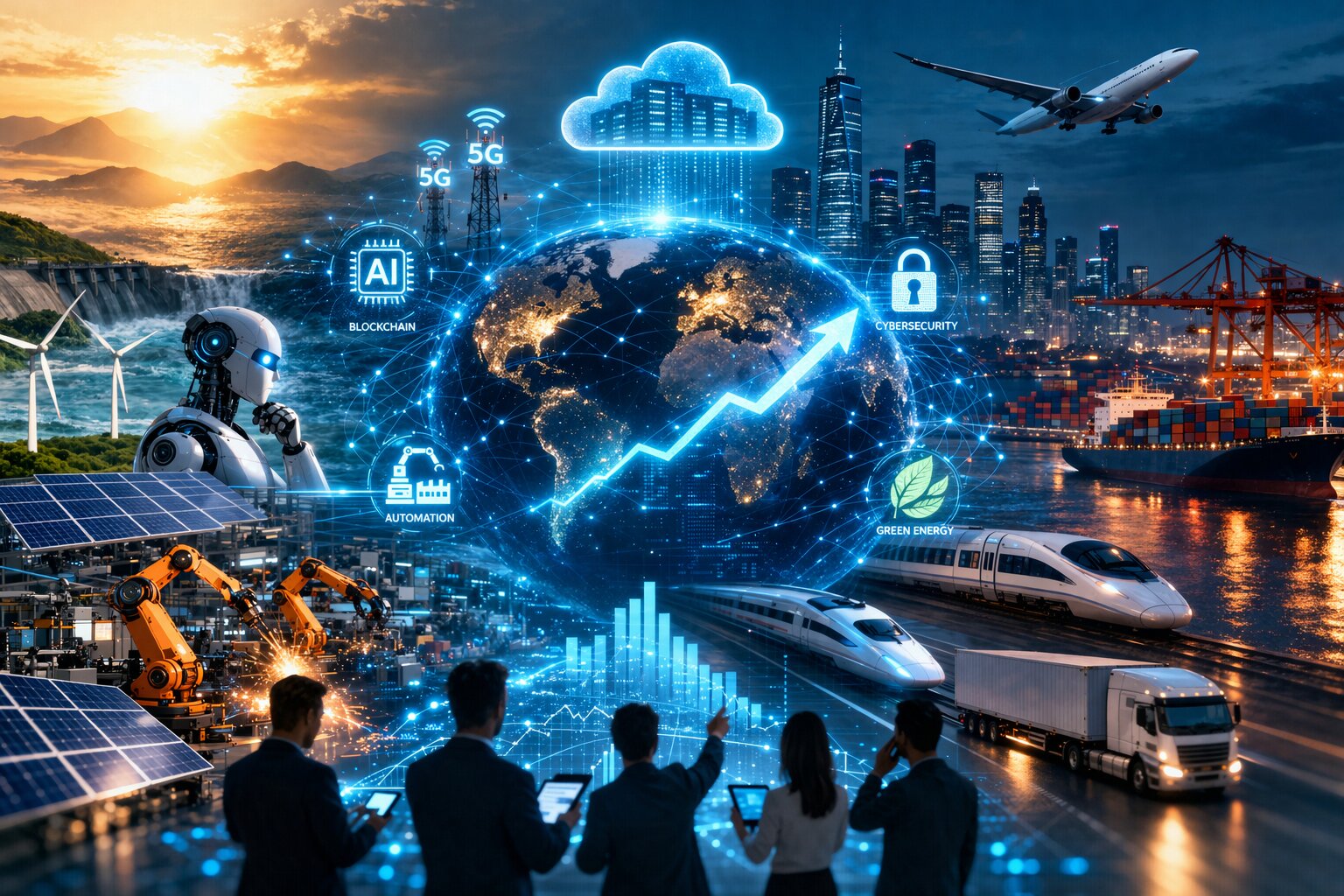
The Biggest Technology Trends Shaping the Global Economy Right Now
The global economy is increasingly defined by technological change. From artificial intelligence and cloud computing to digital infrastructure and automation, the forces shaping industries today are deeply rooted in innovation. What distinguishes the current wave of transformation is not just the pace of change, but its scale—technology is no longer confined to specific sectors but is instead influencing nearly every aspect of economic activity.
Understanding the major technology trends shaping the global economy provides insight into how businesses operate, how governments respond to change, and how societies adapt to new forms of work and interaction. These trends are not isolated developments; they are interconnected shifts that are redefining productivity, competition, and long-term growth.
Artificial Intelligence as an Economic Driver
Artificial intelligence has moved from experimental deployments to a central pillar of economic strategy. Businesses across industries are investing heavily in AI to improve efficiency, enhance decision-making, and create new products and services.
AI-driven automation is transforming workflows, reducing the need for manual processes and enabling organisations to scale more effectively. In sectors such as finance, healthcare, and logistics, AI systems are being used to analyse vast amounts of data, identify patterns, and support complex decisions.
At the same time, generative AI technologies are reshaping creative and knowledge-based work. Tools capable of producing text, images, and code are altering how content is created and how software is developed, raising important questions about productivity, intellectual property, and workforce dynamics.
The economic impact of AI extends beyond individual organisations. Countries are increasingly viewing AI as a strategic asset, investing in research, infrastructure, and talent to maintain competitiveness on a global scale.
The Expansion of Cloud and Digital Infrastructure
Cloud computing has become a foundational element of the modern economy. By enabling on-demand access to computing resources, cloud platforms have lowered barriers to entry for businesses and accelerated digital transformation.
Organisations are moving away from traditional on-premise systems toward cloud-based architectures that offer greater flexibility, scalability, and resilience. This shift is supporting the growth of digital services, remote work, and global collaboration.
At a broader level, digital infrastructure—including data centres, fibre networks, and edge computing systems—is becoming increasingly critical. As demand for data processing grows, investments in infrastructure are expanding to support AI workloads, streaming services, and real-time applications.
This trend is also influencing geopolitics, with countries competing to build and control key elements of the digital infrastructure that underpins the global economy.
Automation and the Changing Nature of Work
Automation is reshaping labour markets and redefining the nature of work. While automation has been a feature of industrial development for decades, recent advances in AI and robotics are expanding its reach into new domains.
Routine and repetitive tasks are increasingly being automated, allowing organisations to improve efficiency and reduce costs. However, this shift is also raising concerns about job displacement and the need for reskilling.
At the same time, automation is creating new roles and opportunities. As businesses adopt advanced technologies, demand is growing for skills in areas such as data analysis, software development, and cybersecurity.
The challenge for policymakers and organisations is to manage this transition in a way that balances economic growth with social stability, ensuring that the benefits of automation are widely distributed.
The Rise of Data as a Strategic Asset
Data has become one of the most valuable resources in the global economy. Organisations are collecting, analysing, and leveraging data to gain insights, optimise operations, and drive innovation.
The ability to process and interpret large datasets is increasingly seen as a competitive advantage. Companies that can effectively use data are better positioned to understand customer behaviour, anticipate trends, and respond to changing market conditions.
This trend is also driving the development of new business models centred around data. Platforms that aggregate and analyse information are creating ecosystems where value is generated through insights rather than physical goods.
However, the growing importance of data raises questions about privacy, ownership, and governance. Regulators are working to establish frameworks that protect individuals while enabling innovation.
Cybersecurity as a Core Economic Concern
As digital systems become more central to economic activity, cybersecurity has emerged as a critical issue. Cyber threats can disrupt operations, compromise sensitive information, and undermine trust in digital systems.
The increasing frequency and sophistication of cyber attacks have led organisations to invest more heavily in security measures. Cybersecurity is no longer viewed as a purely technical issue but as a strategic priority that affects business continuity and reputation.
At the national level, governments are recognising the importance of protecting critical infrastructure and digital assets. This has led to the introduction of new regulations and increased collaboration between the public and private sectors.
The economic impact of cybersecurity extends beyond preventing losses. Strong security practices can enhance trust and enable the continued growth of digital services.
The Evolution of Consumer Technology and Digital Experiences
Consumer technology continues to play a significant role in shaping economic trends. Advances in smartphones, wearables, and connected devices are changing how people interact with technology and with each other.
Digital platforms are becoming central to everyday life, influencing how people shop, communicate, and access information. This shift is driving the growth of e-commerce, digital media, and online services.
Emerging technologies such as augmented reality (AR) and virtual reality (VR) are also beginning to influence consumer experiences, creating new opportunities for engagement and interaction.
These developments are not only affecting consumer behaviour but also shaping business strategies, as organisations seek to meet evolving expectations.
Global Competition and Tech Sovereignty
Technology is increasingly at the centre of global competition. Countries are investing in strategic technologies such as AI, semiconductors, and quantum computing to secure economic and geopolitical advantages.
This has led to a focus on “tech sovereignty,” where nations aim to reduce dependence on foreign technology and build domestic capabilities. Policies aimed at supporting local industries, securing supply chains, and protecting intellectual property are becoming more common.
At the same time, international collaboration remains important, particularly in areas such as research and standard-setting. Balancing competition with cooperation is a key challenge in the evolving global technology landscape.
Sustainability and Green Technology
Sustainability is becoming an increasingly important consideration in the development and deployment of technology. As concerns about climate change grow, there is greater emphasis on reducing the environmental impact of digital systems.
Green technology initiatives are focusing on improving energy efficiency, reducing emissions, and promoting sustainable practices. This includes the development of energy-efficient data centres, renewable energy solutions, and circular economy models.
Technology is also playing a role in addressing environmental challenges. AI and data analytics are being used to optimise energy usage, monitor environmental conditions, and support sustainable development.
The integration of sustainability into technology strategy is likely to become a defining feature of the global economy in the coming years.
A Period of Convergence and Acceleration
What makes the current moment distinctive is the convergence of multiple technological trends. AI, cloud computing, automation, and data analytics are not developing in isolation; they are reinforcing each other, creating new capabilities and accelerating change.
This convergence is leading to the emergence of new industries and business models, while also transforming existing ones. Organisations that can adapt to these changes are likely to gain a competitive advantage, while those that fail to do so may struggle to remain relevant.
Looking Ahead
The technology trends shaping the global economy today are likely to continue evolving, with new developments emerging and existing ones becoming more deeply embedded in everyday life.
For businesses, staying informed and adaptable will be essential. For policymakers, balancing innovation with regulation will remain a key challenge. And for individuals, understanding these trends can provide valuable insight into the future of work, society, and economic growth.
Technology is not just influencing the global economy—it is redefining it. Recognising the forces at play is an important step in navigating an increasingly complex and interconnected world.