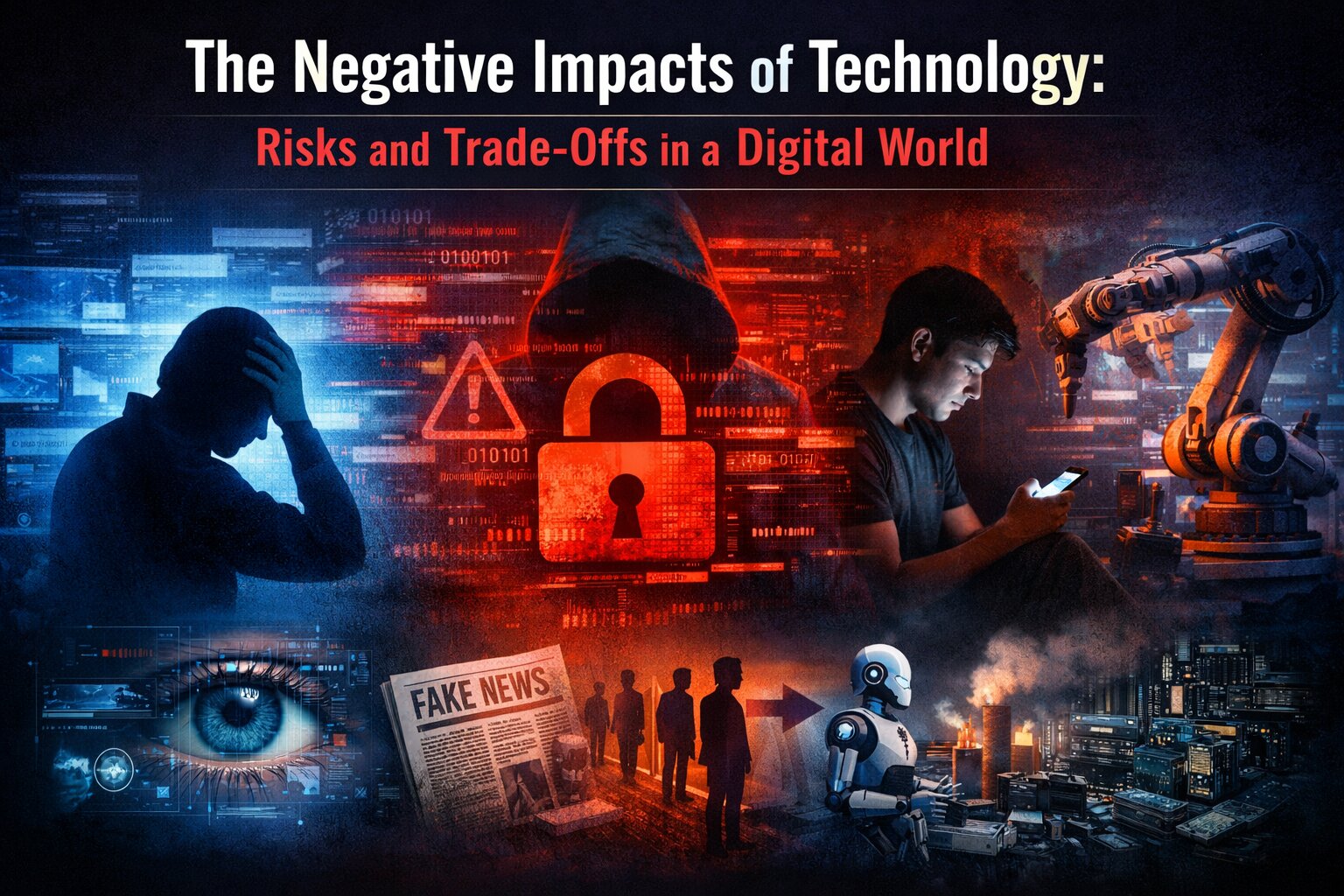
The Negative Impacts of Technology: Risks and Trade-Offs in a Digital World
Technology is often framed as a driver of progress, efficiency, and innovation. It has transformed industries, improved access to information, and reshaped how people live and work. Yet alongside these benefits, there is a growing recognition that technological advancement also brings significant risks and unintended consequences.
Rather than viewing technology as inherently positive or negative, it is more useful to understand it as a force that introduces trade-offs. As digital systems become more deeply embedded in everyday life, these trade-offs are becoming more visible, affecting individuals, businesses, and society at large.
The Erosion of Privacy in a Data-Driven World
One of the most widely discussed concerns surrounding modern technology is the erosion of privacy. As digital platforms collect vast amounts of data, individuals often have limited visibility into how their information is used, stored, or shared.
From social media activity and online purchases to location tracking and biometric data, a significant portion of everyday behaviour is now recorded. While this data enables personalised services and improved user experiences, it also creates detailed profiles that can be exploited for commercial or, in some cases, malicious purposes.
The challenge lies in balancing innovation with individual rights. Many users are unaware of the extent of data collection or the implications of consent agreements, which are often complex and difficult to interpret. As a result, privacy becomes less of a default condition and more of a managed risk.
Cybersecurity Threats and System Vulnerability
As reliance on digital systems increases, so too does exposure to cybersecurity risks. Organisations and individuals are now operating in an environment where cyber threats are not only more frequent but also more sophisticated.
Ransomware attacks, data breaches, and identity theft have become common concerns. Critical infrastructure—including healthcare systems, financial networks, and energy grids—is increasingly targeted, raising the stakes of potential disruptions.
What makes this issue particularly challenging is the asymmetry between attackers and defenders. While organisations must secure complex systems across multiple entry points, attackers often need to exploit only a single vulnerability.
This dynamic means that technological advancement, while enabling new capabilities, also expands the attack surface, creating ongoing security challenges that require constant adaptation.
The Impact on Mental Health and Wellbeing
Technology has transformed communication and access to information, but it has also introduced new pressures that can affect mental health. The constant presence of digital devices, notifications, and online interactions can contribute to stress, distraction, and fatigue.
Social media platforms, in particular, have been associated with issues such as comparison culture, anxiety, and reduced self-esteem. The curated nature of online content can create unrealistic expectations, influencing how individuals perceive themselves and others.
Additionally, the always-connected nature of modern life can blur the boundaries between work and personal time. Remote work technologies, while offering flexibility, can also lead to longer working hours and difficulty disconnecting.
These effects are not uniform, but they highlight the need to consider how technology is designed and used, particularly in relation to human behaviour and wellbeing.
Job Displacement and Workforce Disruption
Automation and artificial intelligence are reshaping labour markets, introducing both opportunities and challenges. While technology can increase productivity and create new roles, it can also displace workers whose tasks are automated.
Industries that rely heavily on routine or repetitive work are particularly affected. As machines and algorithms take over certain functions, workers may need to transition to new roles that require different skills.
This transition is not always straightforward. Reskilling and upskilling require time, resources, and access to education, which may not be equally available to all individuals. As a result, technological change can contribute to economic inequality if not managed carefully.
The broader challenge lies in ensuring that the benefits of automation are distributed fairly, rather than concentrated among a small number of organisations or sectors.
Information Overload and Declining Attention
The digital age has made information more accessible than ever before. While this has clear advantages, it has also led to a phenomenon often described as information overload.
With constant streams of news, updates, and content, individuals are exposed to more information than they can realistically process. This can make it difficult to focus, prioritise, and make informed decisions.
Short-form content and algorithm-driven feeds can further reinforce this effect, encouraging rapid consumption rather than deep engagement. Over time, this may influence attention spans and the ability to engage with complex or nuanced topics.
The challenge is not simply the volume of information, but the way it is presented and consumed. Managing digital consumption has become an increasingly important skill in navigating modern life.
The Spread of Misinformation and Digital Manipulation
Technology has transformed how information is created and shared, but it has also made it easier for misinformation to spread. Social media platforms and digital networks enable content to reach large audiences بسرعة, often without verification.
Misinformation can take many forms, from misleading headlines to deliberately false narratives. In some cases, it is amplified by algorithms that prioritise engagement over accuracy, increasing the visibility of sensational or polarising content.
The implications extend beyond individual misunderstanding. Misinformation can influence public opinion, affect elections, and undermine trust in institutions.
Addressing this issue requires a combination of technological solutions, regulatory frameworks, and media literacy. However, finding effective approaches remains a complex and ongoing challenge.
Dependence on Technology and System Fragility
As societies become more dependent on digital systems, the consequences of failure become more significant. Outages, technical failures, or cyber attacks can disrupt essential services, affecting everything from communication to transportation.
This dependence creates a form of systemic fragility, where disruptions in one area can have cascading effects across others. For example, a failure in a cloud service provider can impact multiple businesses and services simultaneously.
While redundancy and resilience strategies can mitigate these risks, they cannot eliminate them entirely. As reliance on technology continues to grow, ensuring system stability and preparedness becomes increasingly important.
Environmental Impact of Digital Infrastructure
The environmental impact of technology is often overlooked, but it is becoming an increasingly important consideration. Data centres, networks, and devices require significant amounts of energy, contributing to carbon emissions.
The growth of AI and large-scale computing has further increased energy demands. Training complex models, for example, can require substantial computational resources.
At the same time, electronic waste is a growing concern. The rapid pace of technological innovation leads to shorter device lifecycles, resulting in increased disposal and resource consumption.
Efforts are being made to address these issues through more efficient technologies and sustainable practices, but the environmental footprint of the digital economy remains a significant challenge.
Ethical Concerns and Algorithmic Bias
As technology becomes more integrated into decision-making processes, ethical considerations are becoming more prominent. Algorithms are increasingly used in areas such as hiring, lending, and law enforcement, where decisions can have significant consequences.
One of the key concerns is bias. If the data used to train algorithms reflects existing inequalities, the resulting systems may reinforce or even amplify those biases.
This raises questions about fairness, accountability, and transparency. Ensuring that technology is used in a responsible and equitable way requires careful design, testing, and oversight.
Ethical considerations are not limited to bias. Issues such as surveillance, autonomy, and consent are also central to discussions about the role of technology in society.
A More Nuanced View of Progress
The negative impacts of technology do not negate its benefits, but they highlight the importance of a more nuanced understanding of progress. Technological advancement is not a linear path toward improvement; it is a complex process that involves trade-offs and unintended consequences.
Recognising these challenges allows for more informed decision-making, both at an individual and societal level. It encourages a shift from simply adopting new technologies to critically evaluating how they are used and governed.
Balancing Innovation with Responsibility
As technology continues to evolve, the focus is increasingly shifting toward responsible innovation. This involves considering not only what technology can do, but also what it should do.
Businesses, governments, and individuals all have a role to play in shaping the future of technology. This includes developing ethical frameworks, implementing effective regulations, and fostering digital literacy.
Ultimately, the goal is not to slow technological progress, but to guide it in a way that maximises benefits while minimising harm.
Navigating a Complex Digital Landscape
The challenges associated with technology are unlikely to disappear. Instead, they will evolve alongside new innovations and emerging trends.
Understanding the negative impacts of technology is an essential part of navigating this landscape. It provides a more balanced perspective, highlighting both the opportunities and the risks that come with digital transformation.
As society continues to adapt, the ability to critically engage with technology will become increasingly important. In a world shaped by innovation, awareness and responsibility are key to ensuring that progress remains sustainable and inclusive.