
What Is Endpoint Security and Why It Matters in a Connected World
As organisations become increasingly reliant on digital systems, the number of devices connected to networks has grown significantly. Laptops, smartphones, servers, cloud workloads, and Internet of Things (IoT) devices all represent potential entry points into a system. In this environment, protecting the network perimeter alone is no longer sufficient. Security must extend to every individual device—commonly referred to as an endpoint.
Endpoint security has emerged as a critical component of modern cybersecurity strategy. It focuses on protecting devices that connect to a network, ensuring that each endpoint is secure, monitored, and capable of responding to threats. As the attack surface expands, understanding the role of endpoint security becomes essential for businesses and individuals alike.
Defining Endpoints in a Modern Network
An endpoint is any device that connects to a network and exchanges data. Traditionally, this included desktop computers and servers within an organisation’s internal network. Today, the definition has expanded considerably.
Modern endpoints include laptops used by remote workers, smartphones accessing corporate applications, tablets, cloud-based virtual machines, and even connected devices such as smart sensors and industrial equipment. Each of these endpoints represents a potential vulnerability if not properly secured.
The shift toward remote work and cloud computing has further blurred the boundaries of the traditional network. Devices are no longer confined to a central office environment, making it more challenging to maintain consistent security across all endpoints.
Why Endpoint Security Is Increasingly Important
The growing importance of endpoint security is closely tied to changes in how organisations operate. As digital transformation accelerates, more devices are being connected to networks, increasing the number of potential entry points for attackers.
Cybercriminals often target endpoints because they can be easier to compromise than centralised systems. A single compromised device can provide access to sensitive data or serve as a gateway to the broader network.
Phishing attacks, malware infections, and ransomware campaigns frequently begin at the endpoint level. For example, a user clicking on a malicious link or downloading an infected file can inadvertently introduce a threat into the system.
As a result, securing endpoints is not just about protecting individual devices—it is about safeguarding the entire network.
Core Components of Endpoint Security
Effective endpoint security involves multiple layers of protection, each designed to address different types of threats.
Antivirus and Anti-Malware Protection
Traditional endpoint security solutions often begin with antivirus software, which detects and removes known threats. While still important, modern threats require more advanced approaches that go beyond signature-based detection.
Endpoint Detection and Response (EDR)
EDR solutions provide continuous monitoring of endpoint activity, allowing organisations to detect and respond to suspicious behaviour in real time. These systems use analytics and behavioural analysis to identify threats that may not match known patterns.
Firewalls and Network Controls
Endpoint firewalls help control incoming and outgoing traffic, reducing the risk of unauthorised access. These controls can be configured to enforce security policies and limit exposure to potential threats.
Encryption and Data Protection
Protecting data stored on endpoints is essential, particularly for devices that may be lost or stolen. Encryption ensures that sensitive information remains inaccessible without proper authorisation.
Patch Management and Updates
Keeping software up to date is a critical aspect of endpoint security. Vulnerabilities in outdated software can be exploited by attackers, making regular updates and patching essential.
The Role of AI and Automation
Artificial intelligence is playing an increasingly important role in endpoint security. AI-driven systems can analyse large volumes of data to identify patterns and detect anomalies that may indicate a threat.
Automation also helps improve response times. When a potential threat is detected, automated systems can take immediate action, such as isolating a compromised device or blocking suspicious activity.
These capabilities are particularly valuable in environments where the scale and complexity of threats exceed what can be managed manually.
Endpoint Security in a Remote Work Environment
The rise of remote and hybrid work has significantly changed the endpoint security landscape. Employees are now accessing corporate systems from a variety of locations and devices, often outside the traditional network perimeter.
This creates additional challenges, as organisations have less direct control over the environments in which devices are used. Public Wi-Fi networks, personal devices, and unsecured home networks can all introduce risks.
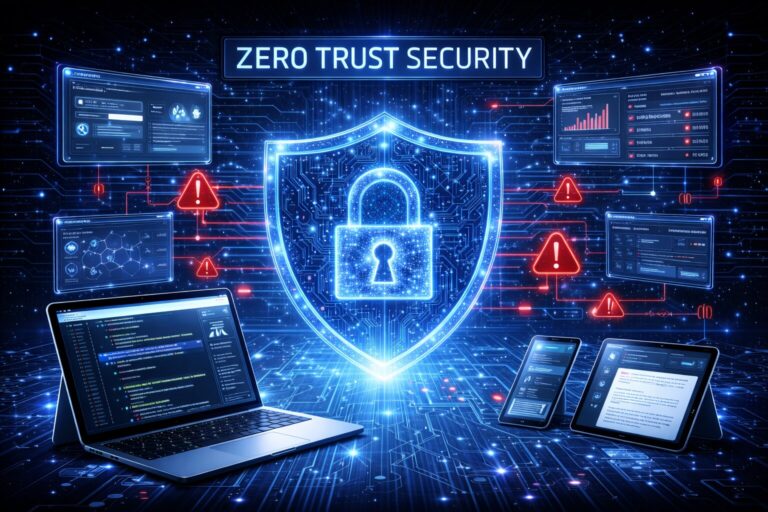
To address these challenges, organisations are adopting approaches such as zero trust security, where every device and user must be continuously verified before accessing resources.
Endpoint security solutions must therefore be capable of operating effectively across diverse and distributed environments.
Challenges in Managing Endpoint Security
While endpoint security is essential, it is also complex to manage.
One of the main challenges is scale. Large organisations may have thousands or even millions of endpoints, each requiring monitoring and protection. Managing this level of complexity requires sophisticated tools and processes.
Another challenge is user behaviour. Many security incidents originate from human error, such as clicking on malicious links or using weak passwords. Educating users and promoting good security practices are therefore critical components of endpoint security.
There is also the issue of evolving threats. Cybercriminals are constantly developing new techniques, requiring security systems to adapt continuously.
The Integration of Endpoint Security with Broader Cybersecurity Strategies
Endpoint security does not operate in isolation. It is part of a broader cybersecurity framework that includes network security, identity management, and threat intelligence.
Integrating endpoint security with other systems allows organisations to gain a more comprehensive view of their security posture. For example, data from endpoint monitoring can be combined with network analytics to identify coordinated attacks.
This integrated approach enhances the ability to detect and respond to threats across the entire organisation.
Regulatory and Compliance Considerations
In many industries, endpoint security is not just a best practice but a regulatory requirement. Organisations may be required to implement specific security measures to protect sensitive data and comply with standards.
Regulations often focus on areas such as data protection, incident reporting, and access control. Failure to meet these requirements can result in financial penalties and reputational damage.
Ensuring compliance requires a clear understanding of regulatory obligations and the implementation of appropriate security measures.
The Future of Endpoint Security
As technology continues to evolve, endpoint security will need to adapt to new challenges and opportunities.
The increasing use of IoT devices, for example, introduces new types of endpoints that may have different security requirements. Similarly, the growth of cloud computing and edge computing is changing how data is processed and stored.
Advances in AI and machine learning are likely to play a central role in the future of endpoint security, enabling more sophisticated detection and response capabilities.
At the same time, there will be greater emphasis on user-centric security, recognising that human behaviour is a key factor in many security incidents.
Securing the Edge of the Digital World
Endpoint security is a fundamental aspect of modern cybersecurity. As networks become more distributed and devices more diverse, protecting individual endpoints is essential for maintaining overall security.
By combining advanced technologies, robust processes, and user awareness, organisations can reduce risks and build more resilient systems.
In a connected world where every device represents a potential entry point, endpoint security is not just an option—it is a necessity.