Why Data Centres Are Becoming the Backbone of the AI Economy
Artificial intelligence has quickly become one of the most powerful forces driving technological innovation. From generative AI tools and autonomous systems to advanced data analytics and cloud services, modern AI applications require enormous amounts of computing power.
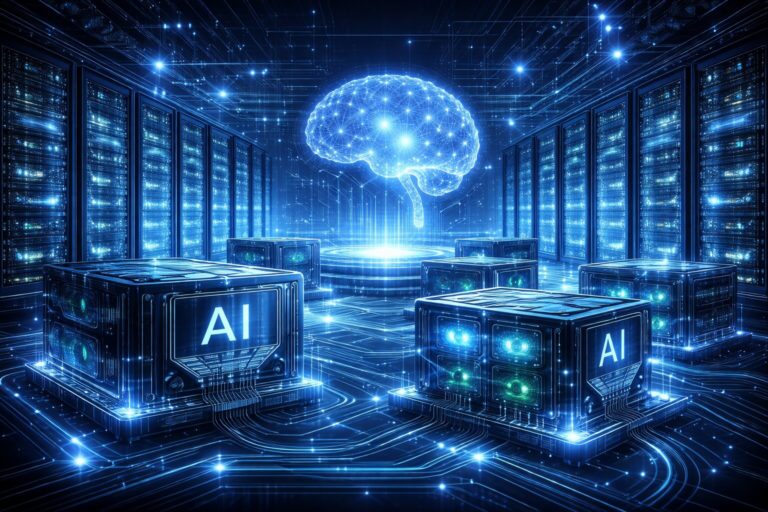
Behind the scenes, this demand is being supported by a rapidly expanding network of data centres. These massive facilities, filled with high-performance servers and advanced networking systems, have become the physical infrastructure powering the AI revolution.
As AI adoption accelerates across industries, data centres are emerging as one of the most important foundations of the global digital economy.
The Growing Demand for AI Computing Power
Training modern artificial intelligence models requires extraordinary computing resources. Machine learning algorithms analyse massive datasets and perform complex mathematical calculations across thousands of processors simultaneously.
The most advanced AI models can take weeks or even months to train using large clusters of specialised hardware.
This growing demand for computing power has placed enormous pressure on digital infrastructure.
Technology companies, research institutions, and cloud providers are investing billions of dollars in new data centre capacity to support AI workloads.
These facilities house the powerful hardware required to train and run large-scale machine learning systems.
Without this infrastructure, many of the AI technologies currently transforming industries would not be possible.
Inside a Modern Data Centre
A modern data centre is far more than a building filled with computers. These facilities are designed to operate as highly efficient and reliable environments for large-scale computing.
Inside a data centre, rows of server racks contain thousands of interconnected machines. These servers are linked by high-speed networking systems that allow them to exchange data extremely quickly.
Specialised hardware such as graphics processing units (GPUs) and AI accelerators play a crucial role in these environments. These processors are designed to handle the parallel computations required by machine learning algorithms.
Cooling systems are another essential component. AI hardware generates significant heat, and advanced cooling technologies are required to maintain stable operating conditions.
Power supply systems and backup generators also ensure that data centres remain operational even during power disruptions.
The Role of Cloud Providers
Much of the global data centre infrastructure is operated by large cloud computing providers.
These companies offer businesses access to powerful computing resources without requiring them to build their own infrastructure.
Instead of purchasing expensive hardware, organisations can rent computing power through cloud platforms.
This model has dramatically expanded access to AI technology. Startups, research teams, and small companies can now train machine learning models using cloud-based resources that would have been impossible to build independently.
Cloud providers are therefore playing a crucial role in accelerating AI innovation.
AI Infrastructure Arms Race
The rapid growth of artificial intelligence has triggered an infrastructure arms race among major technology companies.
Tech giants are competing to build larger and more advanced data centres capable of supporting the next generation of AI systems.
Some companies are constructing massive data centre campuses that contain tens of thousands of servers.
These facilities often require enormous amounts of electricity and advanced cooling technologies.
As a result, technology companies are also investing heavily in renewable energy sources and more efficient hardware designs.
The scale of these investments highlights how critical digital infrastructure has become in the AI era.
Geographic Expansion of Data Centres
The expansion of data centre infrastructure is also reshaping the global technology landscape.
Traditionally, large data centres were concentrated in major technology hubs such as Silicon Valley and parts of Europe.
Today, companies are building facilities in many different regions around the world.
This geographic expansion helps reduce latency by placing computing resources closer to users. It also improves redundancy by distributing infrastructure across multiple locations.
In addition, governments are increasingly competing to attract data centre investments by offering incentives such as tax breaks and renewable energy projects.
As a result, data centre development is becoming an important part of national technology strategies.
Energy and Sustainability Challenges
While data centres are essential for powering modern technology, they also raise significant environmental challenges.
Large computing facilities consume enormous amounts of electricity, particularly when running AI workloads.
As AI adoption continues to grow, the energy demand associated with data centres is expected to increase significantly.
Technology companies are responding by investing in more energy-efficient hardware, advanced cooling systems, and renewable energy sources such as solar and wind power.
Some companies are also experimenting with innovative approaches such as locating data centres near hydroelectric power sources or using waste heat from servers to support nearby infrastructure.
Balancing technological growth with environmental sustainability will be one of the key challenges facing the AI economy.
Edge Computing and Distributed Infrastructure
Although large centralised data centres remain critical, the future of digital infrastructure may also include more distributed computing systems.
Edge computing involves processing certain types of data closer to where it is generated rather than sending everything to central data centres.
For example, smart devices, autonomous vehicles, and industrial sensors may process data locally before sending selected information to cloud platforms.
This approach can reduce latency and improve efficiency for real-time applications.
Edge computing will likely complement large-scale data centres rather than replacing them, creating a hybrid infrastructure model.
The Strategic Importance of Infrastructure
As artificial intelligence becomes more central to the global economy, digital infrastructure is increasingly viewed as a strategic asset.
Countries and technology companies alike recognise that controlling advanced computing infrastructure can provide significant economic and technological advantages.
Access to powerful data centres enables faster AI development, improved digital services, and stronger technological competitiveness.
For this reason, infrastructure investments are becoming a key part of long-term technology strategies.
The Future of the AI Economy
Artificial intelligence is still in the early stages of its development, and the demand for computing infrastructure is expected to grow significantly in the coming years.
New generations of AI models will require even more powerful hardware and larger datasets.
Data centres will therefore remain a critical component of the global technology ecosystem.
At the same time, innovations in hardware design, energy efficiency, and distributed computing may reshape how these facilities operate.
What is clear is that the AI economy cannot exist without the massive computing infrastructure that supports it.
Behind every advanced AI system lies a network of servers, processors, and data centres working continuously to power the digital world.
As artificial intelligence continues to expand into new industries and applications, data centres will remain the backbone supporting this technological transformation.