
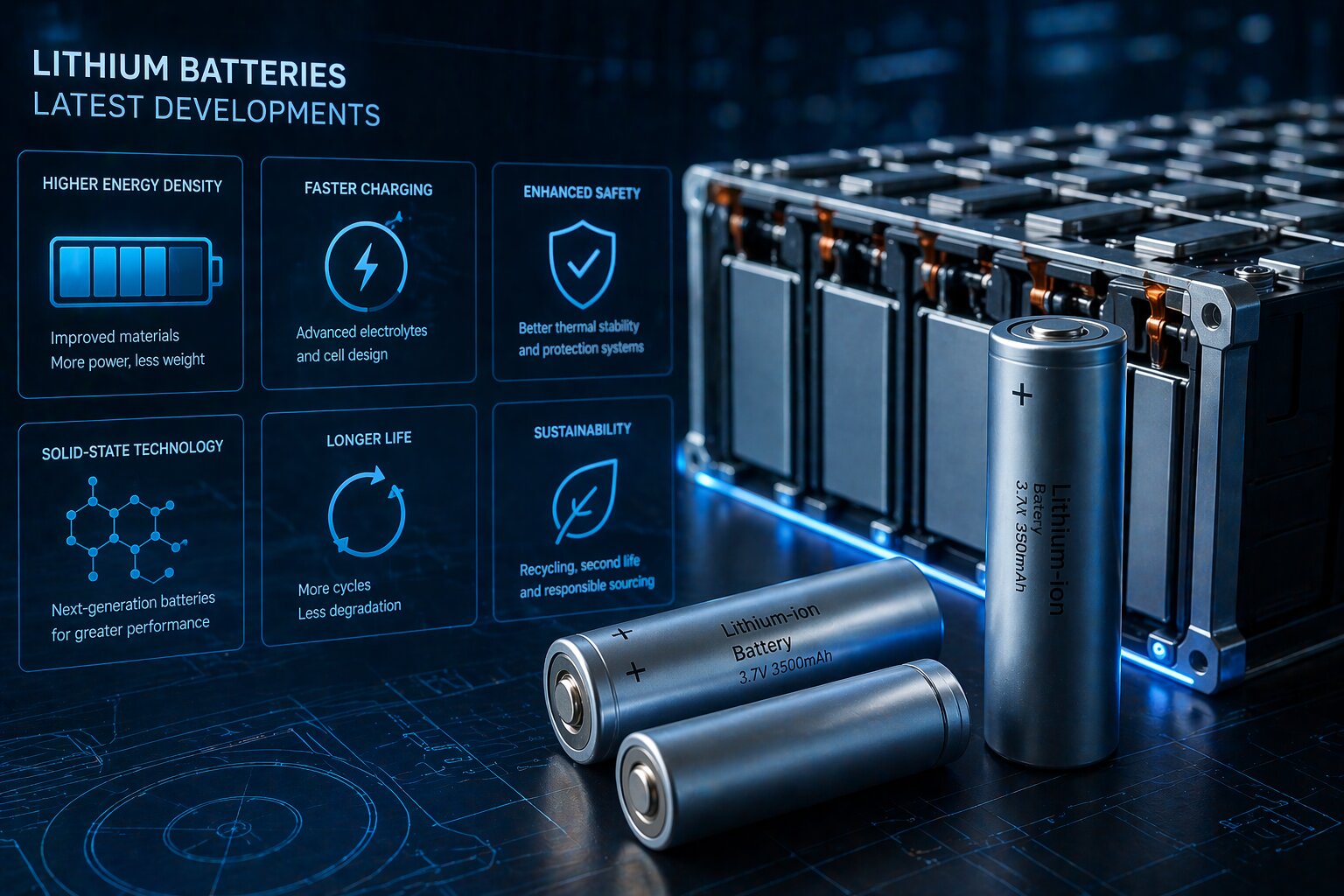
Lithium Batteries: Latest Developments
Lithium batteries have become one of the most important technologies underpinning the modern digital and energy landscape. They power smartphones, laptops, electric vehicles, grid storage systems, wearable devices, and a growing range of industrial applications. For years, lithium-ion batteries have been central to the push toward portable electronics and cleaner transport, but recent developments suggest the technology is entering a new phase.
That next phase is not defined by one dramatic breakthrough alone. Instead, it is being shaped by a combination of advances in chemistry, manufacturing, safety, charging performance, supply chains, and energy density. As demand continues to rise, researchers and manufacturers are working to make lithium batteries more efficient, more durable, less expensive, and better suited to the increasingly wide range of systems that depend on them.
Understanding the latest developments in lithium batteries helps explain not only where battery technology is heading, but also how broader technological change is being enabled. Batteries are no longer just supporting components hidden inside devices. They are becoming strategic technologies with major implications for transport, infrastructure, digital products, and industrial competitiveness.
Why lithium batteries matter so much
Lithium batteries became dominant largely because they offered a combination of properties that few alternatives could match. They are relatively lightweight, have high energy density, and can be recharged many times. These qualities made them ideal for consumer electronics, where portability and battery life became defining product concerns.
As technology evolved, those same advantages made lithium batteries increasingly attractive for electric vehicles and renewable energy storage. A battery system capable of storing more energy in less space is valuable in almost every context, whether inside a mobile phone or a vehicle platform. As the world has become more dependent on connected and electrified systems, the strategic significance of lithium batteries has grown accordingly.
This rising importance has brought greater scrutiny to the technology. It is no longer enough for batteries simply to work. Manufacturers, researchers, and governments are now focused on how they can be improved in terms of charging speed, thermal stability, material sourcing, environmental impact, and long-term performance.
Improvements in energy density
One of the most important areas of development remains energy density. In simple terms, energy density refers to how much energy a battery can store relative to its size or weight. Higher energy density means longer runtime for portable devices or greater range for electric vehicles without requiring larger and heavier battery packs.
Recent work in lithium battery development has increasingly focused on raising this limit. Advances in cathode materials, anode design, and cell architecture are all aimed at improving how much energy can be packed into each battery cell. This matters especially in automotive and aerospace contexts, where weight and space are critical constraints.
For consumer technology, improvements in energy density support thinner devices, longer battery life, and more powerful performance without major increases in size. For transport systems, the stakes are even higher. Even incremental improvements can translate into greater driving range, reduced charging frequency, and more efficient battery pack design.
Although these gains are often gradual rather than dramatic, they remain one of the core areas where battery innovation continues to move forward.
The growing interest in solid-state batteries
Among the most talked-about developments in the battery industry is the push toward solid-state battery technology. Traditional lithium-ion batteries use liquid electrolytes to move ions between electrodes. Solid-state batteries aim to replace that liquid with a solid material, potentially improving safety, energy density, and performance.
The appeal of solid-state batteries lies in several possible advantages. They may reduce the risk of leakage or thermal runaway, support higher energy density, and enable the use of materials that are less practical in conventional battery designs. In theory, this could lead to safer batteries with longer range and faster charging.
However, solid-state technology remains challenging to commercialise at scale. Issues around manufacturing complexity, cost, material compatibility, and durability have slowed widespread deployment. Even so, the level of research and investment in this area suggests that it remains one of the most significant long-term directions for lithium-based battery development.
Rather than replacing conventional lithium-ion systems overnight, solid-state batteries are more likely to emerge gradually, first in specialised applications and later in broader commercial use if manufacturing hurdles can be overcome.
Faster charging and performance gains
Charging performance has become another major area of focus. As users and industries become more dependent on battery-powered systems, charging speed is increasingly seen as part of overall usability. In electric vehicles, long charging times remain one of the most visible barriers to wider consumer confidence. In smaller devices, faster charging supports more continuous and flexible use.
Recent battery developments have therefore focused on enabling quicker charging without causing excessive degradation or safety risks. This is a difficult balance. Fast charging places stress on battery materials, and poorly managed systems can reduce lifespan or increase thermal instability.
Advances in electrode materials, thermal management, and charging algorithms are helping address these challenges. Battery management systems are becoming more sophisticated, allowing charging behaviour to be adjusted dynamically based on conditions such as temperature, state of charge, and battery health.
The result is that newer lithium batteries are often not only larger in capacity or safer in design, but also better managed through software and intelligent control systems. This reflects a broader trend in technology, where hardware improvement and software optimisation increasingly go hand in hand.
Battery safety and thermal management
Safety remains one of the most important concerns in lithium battery development. While lithium-ion batteries are widely used and generally reliable, failures can be serious when they occur. Overheating, internal short circuits, damage, or poor manufacturing can lead to battery fires or thermal runaway events.
For this reason, battery manufacturers are investing heavily in improved safety design. This includes better separators, more stable chemistries, stronger cell packaging, and improved battery management systems that monitor temperature, charge behaviour, and potential faults in real time.
Thermal management has become especially important in electric vehicles and energy storage systems, where large battery packs must operate safely under varying environmental and performance conditions. Cooling systems, cell spacing strategies, and system monitoring are all part of how newer battery platforms are being made safer.
These developments matter because battery adoption at larger scales depends not only on performance, but on trust. Consumers, regulators, and industries need confidence that the systems powering homes, vehicles, and portable devices can operate safely under normal and demanding conditions alike.
New battery chemistries within the lithium family
Not all lithium batteries are the same. Within the broader category, there are multiple chemistries with different strengths and trade-offs. Recent developments have included changes in how manufacturers use materials such as nickel, cobalt, manganese, iron, and phosphate to optimise cost, durability, and performance.
Lithium iron phosphate, often referred to as LFP, has attracted growing interest because it offers strong thermal stability, long cycle life, and reduced reliance on cobalt. Although it generally has lower energy density than some nickel-rich chemistries, its safety profile and cost advantages have made it increasingly attractive for certain electric vehicle and storage applications.
At the same time, nickel-rich battery chemistries continue to be developed where higher energy density is prioritised. These can support longer range and stronger performance, but often involve different cost and supply chain considerations.
This diversity within lithium battery chemistry is important because there is no single perfect battery for every application. The future of battery development is likely to involve a growing mix of chemistries tailored to different needs, rather than one universal solution dominating every market.
Supply chains and material pressures
As lithium batteries become more central to the global economy, attention has increasingly shifted toward the materials required to produce them. Lithium itself is only part of the picture. Battery production also depends on access to other materials, including nickel, cobalt, graphite, manganese, and copper, depending on the battery chemistry involved.
This has made supply chains a major strategic issue. Governments and companies are increasingly aware that battery technology is not just a matter of engineering, but also of resource access, industrial capacity, and geopolitical positioning. The concentration of mining, refining, and cell manufacturing in certain regions has raised concerns about supply resilience and dependency.
In response, many countries are investing in battery supply chain development, recycling infrastructure, and domestic manufacturing capability. Companies are also working to reduce reliance on scarce or politically sensitive materials where possible.
This is one reason battery development is now discussed not only in technical terms, but also in economic and strategic ones. The future of lithium batteries is being shaped as much by industrial policy and resource management as by laboratory breakthroughs.
Recycling and second-life applications
Environmental concerns are also driving innovation. As more lithium batteries reach the end of their usable life, the question of what happens next becomes increasingly important. Disposal, recovery, and reuse are now major parts of the battery conversation.
Battery recycling technology is improving, with growing efforts to recover valuable materials from spent cells and reintroduce them into manufacturing supply chains. This has the potential to reduce pressure on raw material extraction and improve the sustainability of battery production over time.
There is also growing interest in second-life applications. A battery that is no longer suitable for a vehicle may still have enough remaining capacity to serve in less demanding roles, such as stationary energy storage. This can extend the useful life of battery systems before recycling becomes necessary.
These developments reflect a broader maturation of the battery sector. Early growth focused on production and deployment. Now, the industry is increasingly being forced to think in lifecycle terms, from mining and manufacturing to reuse and end-of-life recovery.
The role of lithium batteries in renewable energy systems
Beyond consumer devices and transport, lithium batteries are becoming increasingly important in energy infrastructure. Renewable energy sources such as solar and wind are intermittent by nature, which means energy storage plays an important role in smoothing supply and improving grid stability.
Lithium battery systems are now being used in large-scale energy storage installations to capture power when generation is high and release it when demand rises or renewable output falls. This is helping batteries move from the edge of the energy system toward a more central role in how electricity is managed.
Recent developments in battery scaling, cost reduction, and management systems have made this more feasible. As renewable energy deployment grows, so too does the need for storage technologies that are flexible, responsive, and commercially viable.
This makes lithium batteries part of a much larger shift. They are no longer just enabling portable electronics. They are becoming infrastructure technologies linked to the future of electricity distribution and grid resilience.
Manufacturing scale and industrial competition
Another defining trend is the sheer scale of battery manufacturing expansion. As demand from vehicles, electronics, and energy storage grows, companies are investing heavily in new production facilities and more efficient manufacturing processes. Battery gigafactories have become a symbol of this expansion, reflecting both industrial ambition and the strategic value attached to battery production.
Manufacturing improvements are crucial because even strong battery science means little if production remains too expensive or inconsistent. New techniques in cell design, automation, quality control, and materials processing are therefore as important as advances in chemistry.
This also means the battery sector is increasingly shaped by industrial competition. Regions and companies are competing not only to invent better batteries, but to produce them at scale, at lower cost, and with more reliable supply chains. In practical terms, that competition will influence which battery technologies become dominant and how quickly new developments reach consumers.
What the latest developments really mean
The latest developments in lithium batteries suggest a field that is advancing on multiple fronts at once. There is no single breakthrough that defines the whole picture. Instead, progress is emerging through a mix of better materials, improved design, smarter charging, enhanced safety, expanded manufacturing, and stronger attention to sustainability.
This is important because it reflects how mature technologies often evolve. The future of lithium batteries is unlikely to be shaped by one dramatic invention alone. It will be shaped by the steady accumulation of improvements across chemistry, engineering, software, supply chains, and industrial strategy.
For users, this means better battery life, safer systems, and more practical electrification. For industries, it means more efficient transport, more capable storage systems, and stronger digital infrastructure. For governments, it means energy transition, resource strategy, and industrial competitiveness becoming increasingly tied to battery capability.
A technology still in motion
Lithium batteries are already central to modern life, but they are far from a finished technology. Their current dominance does not mean development has slowed. On the contrary, the pressure to improve them has never been greater. Devices are becoming more capable, transport is becoming more electrified, and infrastructure is becoming more dependent on reliable storage.
That makes battery development one of the most important technology stories of the current era. The latest advances in energy density, charging speed, chemistry, safety, and manufacturing show that lithium batteries are continuing to evolve in ways that will shape how digital and energy systems develop over the coming years.
Rather than being hidden components inside other technologies, batteries are increasingly becoming the story themselves. And as lithium battery development continues, it will remain one of the clearest examples of how progress in one foundational technology can influence the wider direction of innovation.