Computer Security and Forensics Explained
Computer security and digital forensics are two closely connected fields that have become increasingly important in the modern technology landscape. As more of everyday life, business operations, and critical infrastructure move into digital systems, the need to protect those systems has grown significantly. At the same time, when incidents occur, organisations need a way to investigate what happened, understand the impact, and preserve evidence. That is where computer forensics becomes essential.
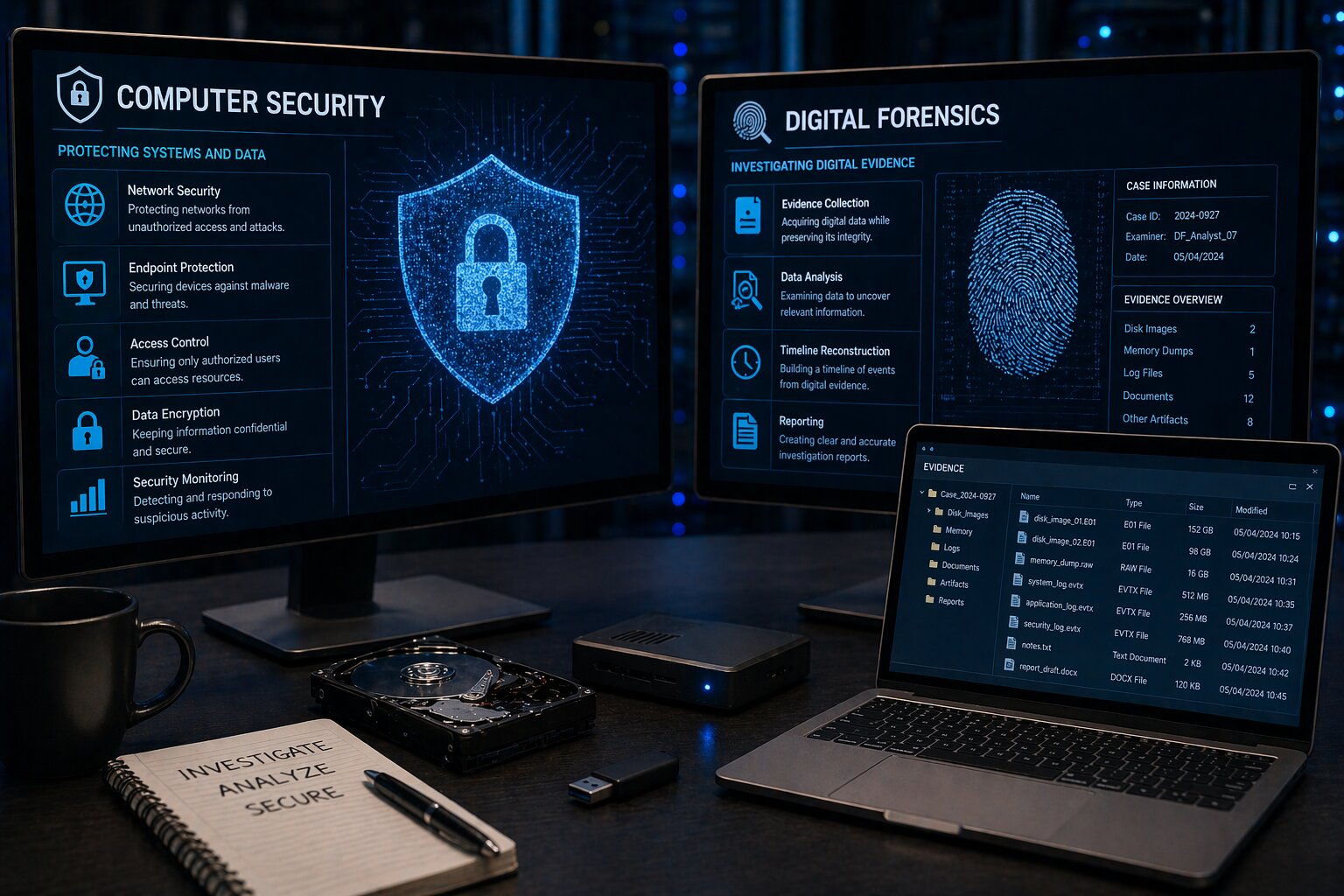
Although the two areas are often discussed together, they serve different purposes. Computer security is focused on prevention, protection, and resilience. It aims to stop unauthorised access, reduce risk, and keep systems functioning safely. Digital forensics, by contrast, is focused on investigation and analysis after an incident or suspicious event has occurred. It is concerned with discovering what happened, how it happened, and who may have been responsible.
Understanding how these fields differ—and how they work together—provides a clearer picture of how modern digital systems are defended, monitored, and investigated.
The purpose of computer security
Computer security is the broader and more preventative of the two disciplines. Its main goal is to protect computer systems, networks, applications, and data from threats such as unauthorised access, malware, phishing, ransomware, insider misuse, and system disruption.
This protection can take many forms. It may involve firewalls, antivirus software, encryption, multi-factor authentication, secure configuration, network segmentation, access control, patch management, and security awareness training. The objective is not simply to stop attacks, but to reduce the likelihood of successful compromise and limit the damage if something does go wrong.
Computer security is also about maintaining trust in digital systems. Users expect systems to protect their information, perform reliably, and resist interference. Businesses depend on secure systems to support operations, customer relationships, financial transactions, and compliance requirements. In that sense, computer security is not just a technical concern. It is a foundation of modern digital life.
The three core principles of security
One useful way to understand computer security is through the core principles often described as confidentiality, integrity, and availability.
Confidentiality means that information should only be accessible to authorised individuals or systems. This includes protecting passwords, personal records, financial data, and sensitive business information from exposure.
Integrity means that data should remain accurate and unaltered unless changed through legitimate and authorised actions. If information is manipulated, corrupted, or tampered with, the integrity of the system is weakened.
Availability means that systems and information should remain accessible when needed. If users cannot reach a service because of an outage, attack, or failure, then security has also been affected.
These principles are central because they show that security is not just about secrecy. It is also about reliability, trustworthiness, and continuity.
Common threats in modern computing environments
The security landscape is shaped by a wide variety of threats. Some are highly targeted and sophisticated, while others are broad, automated, and opportunistic.
Malware remains one of the most familiar risks. This includes malicious software designed to damage systems, steal information, monitor activity, or create unauthorised access. Ransomware, in particular, has become one of the most disruptive types of cyber attack, encrypting files or systems and demanding payment for restoration.
Phishing is another major threat, relying on deception rather than technical exploitation alone. Attackers send messages designed to trick users into revealing passwords, financial details, or other sensitive information. These attacks are effective because they exploit trust and human behaviour.
Other threats include software vulnerabilities, insider misuse, credential theft, weak passwords, insecure configurations, and attacks on cloud environments or connected devices. As digital systems grow more complex, the number of potential attack points also increases.
This is why computer security is not a one-time task. It requires constant monitoring, updating, and adaptation.
What digital forensics involves
Digital forensics, sometimes called computer forensics, focuses on investigating digital evidence in a careful and methodical way. The purpose is to uncover what happened during an incident, preserve evidence in a reliable form, and support legal, disciplinary, or operational outcomes if required.
Forensics may be used after a cyber attack, an internal policy violation, suspected fraud, data theft, or any incident involving digital systems where evidence needs to be examined. The work often involves analysing computers, storage devices, mobile devices, network logs, cloud records, emails, deleted files, and other forms of digital trace data.
The key difference from ordinary troubleshooting is that forensic analysis must preserve the evidential value of the data. It is not just about fixing the problem quickly. It is about understanding the sequence of events and ensuring that any findings can be trusted.
This makes digital forensics both technical and procedural. Investigators need strong analytical skills, but they also need discipline in how evidence is collected and handled.
Why evidence handling matters
One of the most important aspects of digital forensics is the way evidence is preserved. If evidence is altered, contaminated, or poorly documented, its value can be reduced or even lost entirely.
Forensic investigators therefore follow careful processes when handling digital material. They may create forensic images of storage devices rather than examining the original directly. They document where evidence came from, who handled it, when it was accessed, and what steps were taken during analysis. This is often referred to as maintaining a chain of custody.
The reason this matters is that digital investigations may be used in internal inquiries, regulatory reviews, insurance claims, or criminal and civil legal proceedings. In each of these contexts, confidence in the evidence is essential.
Unlike everyday IT work, forensic work is designed to be defensible. The findings must not only be technically accurate, but also procedurally reliable.
Types of digital forensic investigation
Digital forensics can take several forms depending on the nature of the case and the systems involved.
Disk forensics focuses on analysing storage devices, including hard drives and solid-state drives. Investigators may look for deleted files, hidden partitions, timestamps, user activity, or evidence of malicious software.
Memory forensics examines a system’s volatile memory, which can reveal information that may not be stored permanently on disk. This is especially useful for detecting malware, encryption keys, active processes, or network connections during an incident.
Network forensics focuses on traffic and communications moving across networks. This can help identify suspicious connections, data exfiltration, command-and-control traffic, or patterns associated with an attack.
Mobile forensics involves smartphones, tablets, and similar devices, where communications, location data, app activity, and stored files may be relevant.
Cloud forensics is becoming more important as organisations move services and storage into cloud environments. In these cases, investigators may need to analyse logs, account activity, permissions, service usage, and virtual infrastructure rather than physical devices alone.
Each area requires different tools and techniques, but they all contribute to the same broader goal: establishing what happened and supporting an evidence-based understanding of the event.
How security and forensics work together
Although computer security and digital forensics have different purposes, they are closely linked in practice. Security aims to prevent and detect problems, while forensics helps investigate and explain them. In many cases, an organisation needs both.
For example, a security team may detect unusual login activity or suspicious file transfers. That alert may indicate a compromise, but further investigation is needed to determine whether it was malicious, how access was gained, what systems were affected, and whether data was taken. This is where forensic analysis becomes essential.
The findings from forensic work can then feed back into security strategy. If the investigation shows that the incident began with weak credentials, poor patching, or insecure remote access, the security team can strengthen those areas. In this way, forensics does not only look backward. It also helps improve future defence.
The relationship between the two disciplines is therefore cyclical. Security detects and protects. Forensics explains and informs. Together, they contribute to a stronger overall security posture.
The role of logs and system records
One of the most important resources in both security and forensics is system logging. Logs provide records of activity such as logins, file access, software changes, network connections, and administrative actions. Without these records, it becomes much harder to understand what took place during an incident.
From a security perspective, logs support monitoring and alerting. They can help identify unusual behaviour, failed login attempts, privilege escalation, or unexpected changes in the environment.
From a forensic perspective, logs help reconstruct timelines. They can show when an attacker entered a system, what actions they performed, whether data was accessed, and how long they remained active.
This is why logging and retention policies are so important. If logs are incomplete, poorly configured, or deleted too quickly, both security operations and forensic investigations become more difficult. Strong visibility into system activity is one of the most valuable assets an organisation can have.
Challenges in digital investigations
Digital forensics is not always straightforward. One challenge is the sheer volume of data involved. Modern systems generate huge amounts of logs, communications, files, and user activity, making it difficult to isolate the most relevant evidence quickly.
Encryption can also complicate investigations. While encryption is vital for security, it may make certain data inaccessible without the necessary keys or credentials. Investigators therefore need ways to work within secure environments while still preserving evidence.
Cloud and distributed systems add further complexity. In the past, investigators might have had direct access to physical machines. Today, evidence may be spread across cloud providers, mobile devices, remote endpoints, and third-party services. Determining where the relevant evidence exists can be as challenging as analysing it.
There is also the problem of time. In fast-moving security incidents, organisations need quick answers, but forensic accuracy requires care and precision. Balancing speed with evidential reliability is a constant challenge.
Why these fields matter more now
Computer security and digital forensics have both become more important because digital systems are now central to nearly every part of life and business. The consequences of failure are greater than before. A compromise may no longer affect only one workstation or one user. It can disrupt supply chains, expose customer records, halt operations, damage reputation, and trigger regulatory consequences.
At the same time, the digital footprint of individuals and organisations has become much larger. More activity is stored, transmitted, and processed through digital systems, which means there is both more to protect and more to investigate when incidents occur.
This makes the combination of security and forensics essential. Organisations need the ability to reduce risk proactively, detect anomalies quickly, and respond intelligently when something does happen. They also need the ability to investigate with enough rigor to learn from the incident and, where necessary, prove what took place.
A shared role in digital resilience
Computer security and digital forensics serve different but complementary purposes. Security focuses on protecting systems and information from harm, while forensics focuses on understanding and evidencing what happened when a problem or breach occurs. One is preventative and defensive, the other investigative and analytical.
Together, they form a crucial part of digital resilience. Security alone cannot guarantee that incidents will never happen. Forensics alone cannot prevent damage before it occurs. But when combined, they give organisations a stronger ability to protect, detect, investigate, and improve.
In a world where digital systems support everything from communication and commerce to infrastructure and personal data, that combined capability is becoming more important every year. Understanding how computer security and forensics work is therefore not only useful for specialists. It is part of understanding how the digital world is defended, examined, and trusted.