
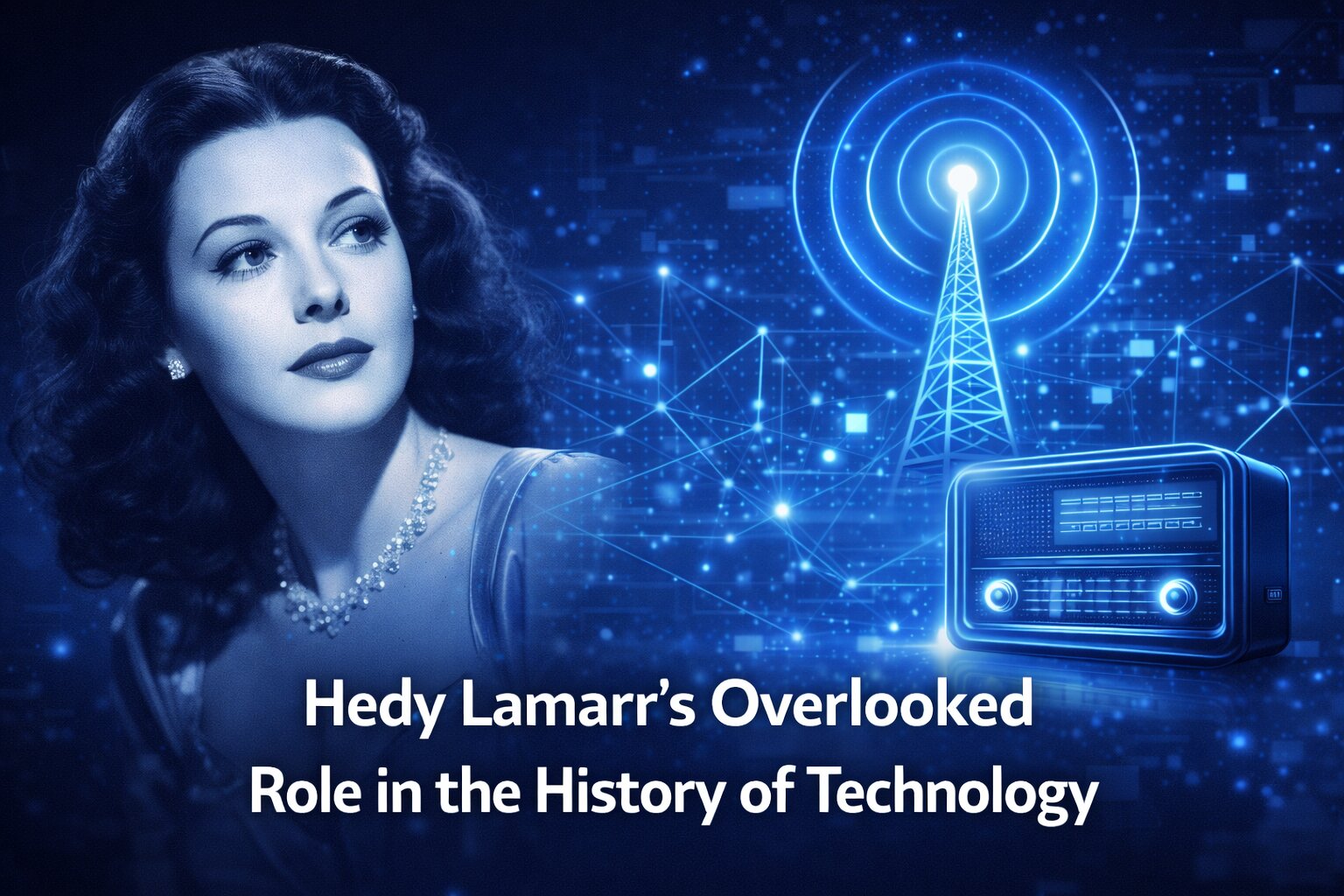
Hedy Lamarr’s Overlooked Role in the History of Technology
When most people hear the name Hedy Lamarr, they think first of Hollywood. She is often remembered as a glamorous film star of the 1930s and 1940s, associated with classic cinema, celebrity culture, and the visual mythology of the golden age of film. Yet that version of Hedy Lamarr tells only part of the story. Long before the modern technology industry became fascinated with innovation, disruption, and hidden genius, Lamarr had already become part of a remarkable chapter in technological history.
What makes her story so compelling is not simply that she was both a film star and an inventor. It is that her contribution to technology was so long overlooked, misunderstood, or reduced to a curious footnote. In reality, Hedy Lamarr’s work sits within a much broader story about communication systems, wartime innovation, and the early ideas that would later help shape modern wireless technology.
Her legacy matters not only because it is historically interesting, but because it challenges common assumptions about who innovation belongs to, how technological progress is remembered, and why some contributions become central to public memory while others remain in the background for decades.
A public image that obscured a different kind of intelligence
Hedy Lamarr entered public life through film, and her reputation was built first through image. In the studio era, actors were often reduced to highly controlled public identities, and Lamarr was no exception. She was presented as elegant, mysterious, and strikingly beautiful. That image became so dominant that it overshadowed other aspects of who she was.
This matters because public narratives about technology have often been shaped by stereotypes. Inventors are frequently imagined as engineers in laboratories, founders in garages, or technical specialists working inside institutions. Someone associated with glamour and celebrity did not fit the expected mould. As a result, Lamarr’s technical curiosity was often treated as surprising, rather than taken seriously on its own terms.
Yet by many accounts, she had long shown an interest in how things worked. She was not simply attached to the world of ideas as a hobbyist in the most trivial sense. She was deeply curious, mechanically minded, and drawn to problem-solving. That combination of curiosity and imagination would eventually lead to her involvement in a technological idea with much wider implications than many people realised at the time.
Innovation in the context of war
To understand the significance of Hedy Lamarr’s contribution, it helps to look at the historical context in which it emerged. The early 1940s were defined by global conflict, accelerated research, and a growing urgency around military technology. Communications, targeting systems, and signal security were becoming increasingly important.
During this period, Lamarr worked with composer and fellow inventor George Antheil on an idea designed to improve the guidance of radio-controlled torpedoes. The core problem they were responding to was straightforward but important: if a torpedo were guided by radio signal, that signal could potentially be intercepted or jammed by an enemy. In military terms, that made the technology vulnerable.
Their proposed solution involved a communication method in which the transmission would rapidly switch frequencies in a coordinated pattern between sender and receiver. Because the signal would not remain on one fixed frequency, it would be harder to detect, disrupt, or jam. In modern terms, this is commonly referred to as frequency-hopping spread spectrum.
At the time, the idea was highly innovative. It brought together principles of communication security, signal engineering, and coordinated switching in a way that was far ahead of what many people expected from civilian inventors working outside formal military research structures.
Why the idea was so important
The reason Lamarr’s work continues to attract attention today is that the underlying concept behind frequency-hopping became significant well beyond its original wartime context. Although her patent was not immediately adopted in the form she had envisioned, the core principle would later prove valuable in communications technology.
Spread-spectrum approaches became important because they improved the resilience and security of wireless communication. By making signals less predictable and less vulnerable to interference, these methods opened the door to more robust forms of radio transmission. Over time, related principles contributed to the technological foundation for systems that would eventually be relevant to wireless networking, Bluetooth, and other modern communication tools.
It is important not to oversimplify this history. Hedy Lamarr did not “invent Wi-Fi” in the direct, simplified way that headlines sometimes suggest. Modern wireless technologies emerged through decades of research, engineering, standard-setting, and infrastructure development involving many people and institutions. But it is equally important not to minimise her role. The communication concept she helped develop belongs within the broader lineage of technologies that shaped secure and adaptive wireless transmission.
In other words, her contribution was not a marketing myth, but nor should it be reduced to an exaggerated slogan. Its real significance lies in how early and how imaginative it was.
The problem of delayed recognition
One of the most revealing aspects of Hedy Lamarr’s story is how long it took for her technological contribution to receive meaningful public recognition. For much of her life, the inventor side of her work remained marginal in public discussion. She was celebrated for fame, beauty, and film history, while her technical legacy remained comparatively obscure.
This delay reflects a wider pattern in the history of science and technology. Recognition is not distributed evenly, and it is not always determined solely by the quality of the work itself. Public memory is shaped by institutions, media narratives, gender expectations, access to power, and the kinds of expertise a culture chooses to legitimise.
In Lamarr’s case, several factors likely contributed. She was working at a time when women were often systematically underestimated in technical fields. She was also known primarily as a film star, which made it easier for commentators to treat her inventive work as an anomaly rather than a serious intervention. In addition, the wartime and postwar context meant that some technologies were developed, classified, adapted, or ignored according to institutional priorities beyond the control of individual inventors.
What makes her later recognition meaningful is not just that it corrected a biographical oversight. It also exposed how narrow the public imagination around invention can be.
A story about interdisciplinarity before the term became fashionable
One reason Hedy Lamarr’s story resonates so strongly today is that it feels unexpectedly modern. The technology sector often celebrates interdisciplinary thinking, the collision of different worlds, and the value of combining creative and technical insight. Lamarr embodied that kind of crossover long before it became part of innovation culture’s preferred language.
Her collaboration with George Antheil is especially revealing in this respect. Antheil was known as a composer, and their work together has often been described as unusual because it appeared to connect music and engineering. But that is precisely what makes it interesting. Their synchronisation idea has often been linked to the use of piano-roll logic as a way of imagining coordinated frequency switching. Whether discussed symbolically or technically, the collaboration illustrates a broader point: innovation does not always emerge from conventional pathways.
Today, organisations often say they value diverse thinking, non-linear backgrounds, and cross-disciplinary collaboration. Lamarr’s story is a reminder that these qualities have always had value, even if institutions have not always known how to recognise them.
Why her legacy fits the digital age
The reason Hedy Lamarr’s legacy feels especially relevant now is that the digital age depends so heavily on invisible systems of communication. Modern life is built on wireless signals, networked devices, encrypted transmissions, and layers of technical infrastructure that most users rarely see. The reliability of these systems depends on principles that can sound abstract until they fail.
In that sense, Lamarr’s contribution sits at a very contemporary intersection: security, communication, signal resilience, and the hidden architecture of connection. Dykes Do Digital covers technologies that shape everyday life while often operating beneath the surface, and her story belongs naturally in that landscape.
She also represents something else that feels increasingly important in contemporary technology culture: the need to tell fuller, more accurate stories about innovation. As the tech sector reflects more on access, attribution, and the narratives it privileges, figures like Lamarr become more than historical curiosities. They become a way of asking better questions about how progress is remembered.
The risks of turning her into a simplified icon
At the same time, there is a risk in how Hedy Lamarr is discussed today. In recent years, her story has sometimes been compressed into a feel-good viral fact: a glamorous actress who secretly invented the future. While that framing has helped introduce her to wider audiences, it can also flatten the complexity of what actually happened.
The problem with simplified narratives is that they often replace one distortion with another. If Lamarr was once dismissed because of her public image, she can now be over-romanticised through a modern myth of hidden genius. Neither version fully respects the historical reality.
A more serious reading of her contribution requires balance. It means acknowledging that she was intellectually ambitious and genuinely inventive, while also recognising that technological change is cumulative and collective. It means seeing her not as a magical exception but as a person whose work deserves a proper place in the history of communications technology.
This more grounded interpretation is ultimately more respectful than the simplified version, because it treats her contribution as real history rather than anecdote.
Gender, memory, and the politics of recognition
It is impossible to discuss Hedy Lamarr’s technological legacy without also touching on gender. The history of technology has long been marked by omissions, and women’s contributions have frequently been under-credited, misattributed, or remembered only later. Lamarr’s story is not identical to every other case, but it clearly belongs within this broader pattern.
The issue is not only one of fairness to the past. It also shapes how the present imagines who belongs in technology. Historical narratives do cultural work. They influence who is visible, whose expertise is taken seriously, and what kinds of people are seen as natural participants in innovation.
When a figure like Hedy Lamarr is brought back into focus, the effect is larger than biography. It helps widen the frame. It reminds audiences that technological creativity has never belonged exclusively to one kind of person, one institution, or one professional pathway.
That reminder remains important in a digital culture that still struggles with representation, gatekeeping, and narrow ideas about technical authority.
Invention outside the startup myth
Another reason Lamarr’s story stands out today is that it offers a counterpoint to the dominant mythology of modern tech culture. The contemporary innovation narrative often centres on founders, venture capital, product launches, and startup ecosystems. Progress is framed as something driven by branded companies and visible commercial success.
Lamarr’s contribution sits far outside that framework. It emerged from wartime urgency, private curiosity, collaboration, and a technical idea whose value was not fully realised in the moment of its creation. There was no startup arc, no product keynote, and no rapid personal payoff. In that sense, her story reflects a quieter and more historically common truth: innovation often begins as an idea whose future significance is not yet obvious.
That makes her legacy useful not just as a corrective to gendered history, but also as a corrective to simplified ideas about where technology comes from. Important ideas can emerge from unexpected people, outside dominant systems, and long before the world is ready to make use of them. This is still relevant today, even when we consider artificial intelligence and its impact upon jobs.
A legacy worth preserving properly
As digital publications increasingly revisit overlooked figures in technology history, Hedy Lamarr deserves more than token inclusion. She represents a story that sits at the intersection of communication, creativity, public image, and delayed recognition. Her contribution does not need embellishment to be impressive. It is already significant.
For a site like Dykes Do Digital, her story also serves another purpose. It broadens the conversation about technology beyond products and platforms, placing historical depth alongside modern innovation. It reminds readers that the digital world did not simply appear fully formed. It was built through layers of experimentation, imagination, overlooked insight, and technical persistence.
Understanding those histories matters because it helps us understand the present with more nuance. Wireless technology, secure communication, and resilient networks are all part of everyday life now. Looking back at the early conceptual groundwork behind them allows us to see the digital world not just as a set of current tools, but as the result of long and often surprising trajectories.
Why Hedy Lamarr still matters
Hedy Lamarr’s overlooked role in the history of technology matters for several reasons at once. It matters because her work helped anticipate an important communication principle. It matters because her recognition was delayed in ways that reveal broader cultural blind spots. And it matters because her story continues to challenge assumptions about who gets remembered as an innovator.
In the end, her legacy is not simply that she was a film star who happened to invent something. It is that she contributed to a technological idea whose significance became clearer over time, even if public understanding took far too long to catch up.
That makes her more than a historical curiosity. It makes her part of a deeper, more interesting history of technology—one in which communication, creativity, and overlooked intelligence all played a role in shaping the connected world that followed.