How Digital Music Interfaces Helped Shape Modern Software Design
Software design is often discussed in terms of the present. Conversations tend to focus on artificial intelligence, mobile-first experiences, automation, or the future of cloud-based tools. Yet many of the design patterns, interaction models, and usability expectations that define modern software were shaped much earlier, often through products that seemed highly specific to their own era. Digital music software is one of the clearest examples.
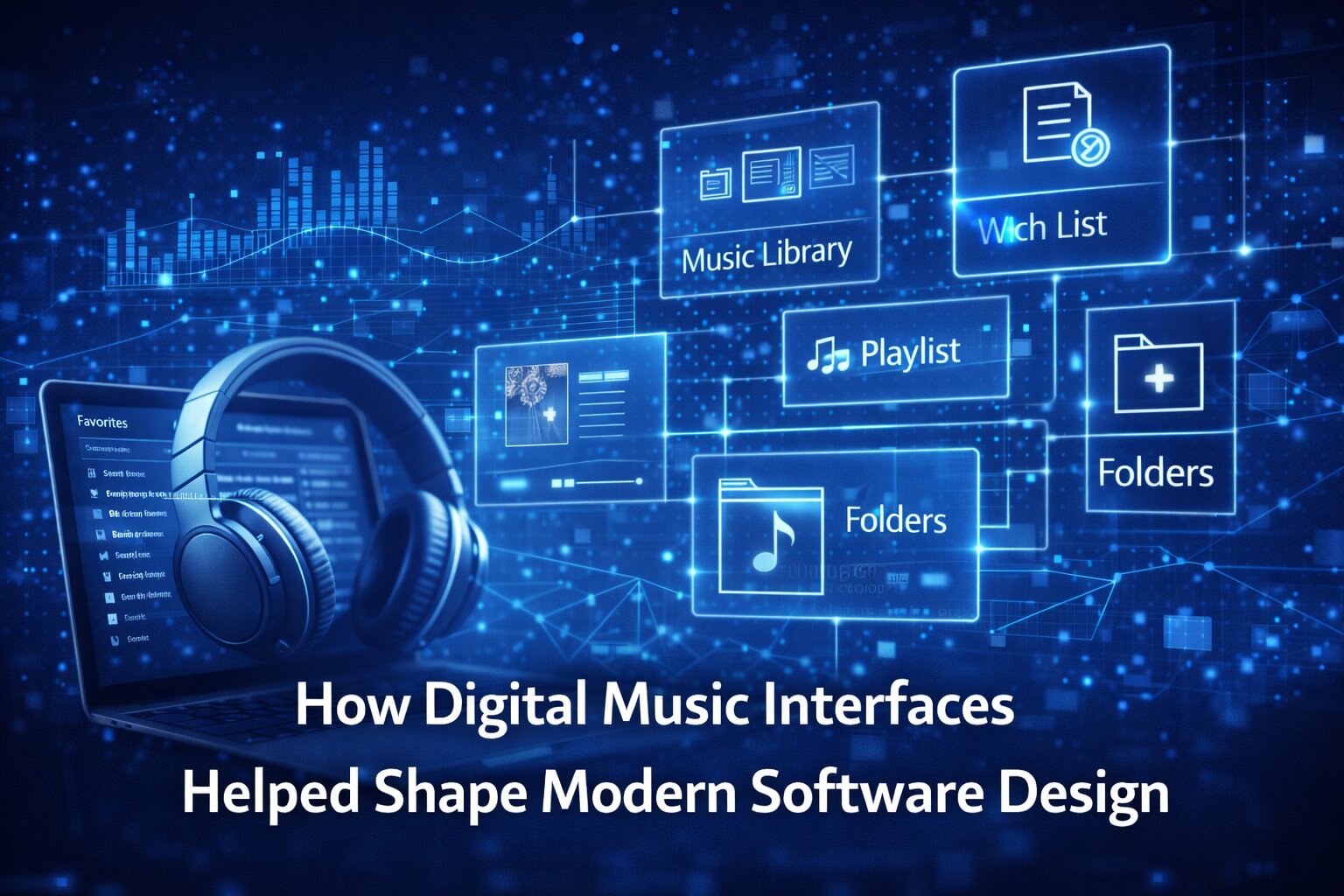
For a generation of users, music platforms were more than entertainment tools. They were among the first widely used systems for organising large personal libraries, syncing across devices, managing metadata, searching at scale, building custom collections, and interacting with software in a way that felt both personal and structured. Features such as playlists, folders, wish lists, ratings, recommendations, and library views helped define how people expected digital interfaces to behave.
What now looks ordinary in contemporary software was often learned in environments built around media. In that sense, digital music interfaces did far more than change how songs were purchased, stored, and played. They quietly influenced how people understood navigation, personalisation, and control in software more broadly.
Music software as an early everyday interface laboratory
One reason digital music interfaces were so influential is that they reached people outside traditional computing or enterprise contexts. Many users who were not interested in software for its own sake still found themselves spending significant time inside music applications. They browsed albums, edited track information, sorted libraries, built collections, created smart lists, and explored recommendation-driven systems. These were not fringe behaviours. They became normal parts of digital life.
This mattered because software habits are often formed through repeated, low-friction interaction. A user might not consciously think about interface hierarchy, tagging systems, or filtering logic, but repeated use of these features creates an intuitive understanding of how digital systems should work. Music platforms taught users to expect search bars, side navigation, sorting options, ratings, previews, metadata panels, drag-and-drop organisation, and synchronised experiences across devices.
In many ways, music applications became one of the first environments where large numbers of people learned how to manage a personal digital ecosystem. Unlike static webpages, these platforms were interactive, layered, and highly structured. They encouraged users to think in terms of libraries, categories, and personalised systems of organisation. That influence spread far beyond music.
The importance of the digital library model
One of the most significant contributions of music software to modern software design was the library model. Before streaming became dominant, digital music platforms encouraged users to think of content as something that could be collected, arranged, and curated. Songs were not just consumed; they were organised into a system.
This library mentality proved powerful because it mapped neatly onto later software environments. Photo apps, note-taking tools, document management systems, reading apps, and even productivity platforms borrowed heavily from the same logic. Users became comfortable with the idea that software should help them manage large amounts of content through categories, searchable fields, and personal collections.
Libraries also introduced the expectation that software should remember user preferences and preserve structure over time. A collection was not just a temporary session. It was an evolving digital environment shaped by the user. That idea became fundamental to modern applications. Today, users expect continuity across platforms, persistent organisation, and the ability to customise how information appears. Music interfaces helped normalise all of that.
Playlists as an early model of user-defined experience
The playlist may now seem simple, but its broader design influence is easy to underestimate. A playlist is not just a list of songs. It is a user-defined interface object: a custom container created by the user, named by the user, arranged by the user, and revisited over time. That is a powerful concept in software design.
Playlists introduced a model in which users were not merely passive recipients of content. They were active organisers, curators, and editors of their own digital environment. This same logic can be seen now in saved collections, boards, pinned lists, grouped tasks, custom dashboards, and many other interface features across software categories.
The popularity of playlists also taught software companies that users value lightweight personal structure. Not every user wants full complexity, but many want enough flexibility to impose meaning on content. That balance between simplicity and control became central to modern product design. Give users too little control and the experience feels rigid. Give them too much and it becomes confusing. Music platforms helped software designers observe how users interacted with mid-level personalisation tools that were intuitive yet meaningful.
There was also an emotional dimension. Playlists were practical, but they were also expressive. They showed that software structures could carry identity, memory, and mood. This has influenced how many platforms now think about personal curation, from video watchlists to saved article folders to mood-based recommendation systems.
Folders, hierarchy, and navigational logic
The role of folders in digital music interfaces is another often-overlooked piece of software history. Folders represented one of the clearest ways in which real-world organisational metaphors were translated into digital form. They gave users a sense of spatial and structural control. Even when users did not explicitly think about taxonomy, folders helped them understand that software could mirror human habits of categorisation.
This hierarchical logic became central to software design across many categories. Email systems, cloud storage tools, project management platforms, and document apps all rely on similar principles. The presence of parent and child levels, grouped collections, expandable menus, and layered organisation owes something to years of user familiarity with folder-based systems in media and file management tools.
What music software added to this was a hybrid model. Users could organise by folder, but also by artist, album, genre, rating, or search term. That combination of hierarchy and fluid filtering helped shape a more modern understanding of digital navigation. Information did not need to live in only one place conceptually. It could be reached through multiple routes. This approach is now basic to good interface design, but it was not always so obvious. Music applications helped make it feel natural.
Metadata as a hidden design revolution
Perhaps one of the most important yet least visible contributions of digital music software was the way it introduced ordinary users to metadata. Album names, track titles, artist information, genres, release dates, track numbers, ratings, and artwork all formed a metadata layer that determined how a music library could be sorted and experienced.
This was significant because metadata quietly changed expectations around digital organisation. Users learned that content could be enhanced, filtered, and transformed by structured information attached to it. A song was not just a file. It was a file with attributes that made it searchable, sortable, and contextual.
That principle now underpins much of modern software. Photos are organised by date, location, recognition, or labels. Documents can be filtered by author, project, version, or status. Ecommerce systems rely on attributes and tags. Content management systems depend on categorisation structures. Recommendation engines rely on signals and descriptive layers. Music platforms made metadata visible in a way that helped users intuitively grasp its value.
In a broader sense, digital music interfaces helped train users to expect structured information around content, rather than content existing in isolation. That expectation remains central to contemporary software design.
Search, discovery, and the expectation of immediacy
Digital music platforms also played a major role in normalising fast search and discovery. As music collections grew, simple browsing was no longer enough. Users needed to find tracks instantly, explore by keyword, jump between categories, and discover content based on similarity or preference.
This expectation of immediacy shaped software far beyond media. Search is now treated as a default feature in almost every meaningful application. Whether in messaging platforms, project tools, document systems, ecommerce sites, or note-taking apps, users assume they should be able to retrieve content quickly and precisely. Music interfaces helped establish that behavioural norm.
Discovery systems mattered too. Once platforms moved beyond simple ownership models and toward suggestion, recommendation, and exploration, users became familiar with the idea that software could proactively surface relevant content. That pattern is now everywhere, from streaming and shopping to productivity and news. Recommendation is no longer seen as a specialist feature. It is a normal part of interface logic.
What music software proved early was that discovery could be made to feel both helpful and personal. The best systems did not simply show more content; they created a sense of guided exploration. That remains one of the most important ambitions in software design today.
Wish lists and deferred action design
Wish lists may seem minor compared with search or playlists, but they were an important design mechanism because they introduced a structured form of deferred intention. A user did not need to act immediately. They could save an album, mark a song, note something for later, or preserve interest without forcing a purchase or download in the current moment.
That pattern is now deeply embedded across digital systems. Save for later, bookmark, add to list, watch later, star, favourite, and pin are all descendants of the same behavioural logic. They recognise that software is often used across time, not just in isolated sessions. Users need ways to mark relevance before taking final action.
This shift was significant because it made software feel less transactional and more supportive of human behaviour. People browse, hesitate, return, compare, forget, and rediscover. Interfaces that support those patterns feel more natural. Digital music systems helped demonstrate the value of this kind of design long before it became widespread in ecommerce and productivity environments.
Wish lists also revealed something important about user psychology: people value software that acknowledges intention even when action is incomplete. That principle continues to influence feature design across contemporary platforms.
Syncing, ecosystems, and the rise of continuity
Another major contribution of digital music software was the normalisation of synchronisation. Whether through devices, desktops, libraries, or later cloud systems, users became accustomed to the idea that their digital experience should travel with them. Their songs, playlists, ratings, and preferences were expected to persist across environments.
This expectation fundamentally shaped modern software. Today, cross-device continuity is no longer a premium feature. It is basic infrastructure. Users expect notes, settings, watch histories, files, messages, and activity states to remain consistent across hardware and sessions. The inconvenience of broken continuity is now sharply felt because users have been conditioned for years to expect seamlessness.
Music systems were among the first consumer platforms to make this emotionally meaningful. A broken sync was not just a technical error; it disrupted a personal environment. That helped software companies recognise that continuity is not merely operational. It is part of the perceived reliability and emotional coherence of a digital product.
This insight now shapes everything from onboarding and account systems to cloud storage and device ecosystems. Digital music helped make synchronised identity and continuity part of mainstream software expectations.
Interface minimalism and layered complexity
Music applications also influenced software design by showing how to combine clean visual presentation with hidden depth. The best interfaces often looked simple on the surface but allowed for sorting, editing, filtering, syncing, and custom arrangement underneath. That balance between visual calm and functional depth remains one of the hardest goals in software design.
Too much visible complexity can overwhelm users. Too little functionality can make software feel shallow. Music software offered a strong case study in how to stage complexity. Users could begin with playback and browsing, then gradually discover ratings, metadata editing, smart lists, syncing rules, or library preferences.
This progression model has influenced many other types of software. Onboarding flows, progressive disclosure, contextual controls, and modular interfaces all reflect a similar ambition: make the software approachable first, powerful second. Digital music interfaces helped prove that users would engage deeply with systems if the path into complexity felt natural.
The emotional layer of software design
One reason digital music interfaces were so influential is that they were tied to something people cared about intensely. Music is emotional, social, and personal. That meant users brought a different level of attention and attachment to the interface than they might have in a more neutral environment.
This had an important effect on software expectations. Users noticed when a system felt awkward, elegant, intuitive, or frustrating because the content mattered to them. In that sense, music platforms became high-pressure environments for interface quality. When design worked, it felt empowering. When it failed, it felt intrusive.
That emotional context likely accelerated broader lessons in software design. Products were not just judged on technical function, but on how they shaped feeling, flow, and identity. This is now central to modern product design, where experience is treated as a competitive differentiator. Music software helped establish that users form emotional judgments about interface design even when they are not using the language of design itself.
From media management to platform thinking
As digital music evolved into ecosystems rather than standalone tools, it also influenced platform thinking more broadly. Music software began as something closer to file management, but over time it absorbed commerce, recommendation, identity, syncing, subscriptions, device integration, and cloud logic. It became not just an app, but a platform layer.
This mattered because it foreshadowed how many other software categories would evolve. Apps no longer stayed narrow for long. They became ecosystems connecting content, services, identity, and multiple forms of interaction. Music platforms showed early how software could become an environment rather than a utility.
That transition is now visible across countless categories. Productivity tools incorporate collaboration, storage, AI, and communication. Ecommerce platforms combine discovery, payment, recommendation, and logistics. Learning apps blend content, progress tracking, social features, and subscription models. The platformisation of software has many sources, but digital music was one of the clearest early consumer examples.
What modern software still owes to music interfaces
The influence of digital music interfaces is still visible in contemporary software, even if it often goes unacknowledged. Saved collections, custom lists, search-first design, metadata-driven organisation, personal recommendations, cross-device continuity, expressive curation, and layered interface depth all bear traces of ideas normalised in media environments.
This does not mean music software single-handedly created modern software design. Many forces shaped the current landscape, including web development, enterprise computing, mobile ecosystems, gaming, search engines, and social media. But digital music deserves a more important place in that history than it usually receives.
Its significance lies partly in scale and familiarity. Music platforms reached millions of ordinary users and taught them how to interact with structured digital environments. They transformed organisational concepts into habits and expectations. Once those expectations were established, other software categories could build on them.
Why this history matters
Looking back at digital music interfaces is not just an exercise in nostalgia. It is useful because it shows how software history often develops through ordinary consumer interaction rather than only through visible technical milestones. Design norms emerge through repeated use, familiar tools, and products that become embedded in everyday behaviour.
For Dykes Do Digital, this kind of software history matters because it adds depth to how we understand the present. Many of the features people now treat as universal were once learned through specific products and categories. Recognising that helps us see software design not as a fixed discipline, but as something shaped gradually by culture, habit, and interface experience.
The story of wish lists, playlist folders, metadata, and digital libraries is therefore larger than music. It is part of the story of how users learned to live inside software.
A quiet foundation for modern interface design
Digital music software did more than organise songs. It taught users how to organise digital life. Through libraries, playlists, folders, ratings, wish lists, syncing, and discovery systems, it introduced patterns that would spread across apps, platforms, and devices far beyond entertainment.
Its influence was quiet but far-reaching. It helped normalise personal curation, structured metadata, fast search, multi-device continuity, and user-defined organisation. These are now foundational elements of modern software design.
That is why digital music interfaces deserve to be remembered not only as part of media history, but as part of software history. They helped shape how software feels, how users expect it to behave, and how digital environments are now built. For a connected world increasingly defined by interface logic, that is a legacy more important than it may first appear.
If you have your own recollections of how digital music interfaces have changed, then you may wish to write a tech guest post – we’re always open to suggestions.