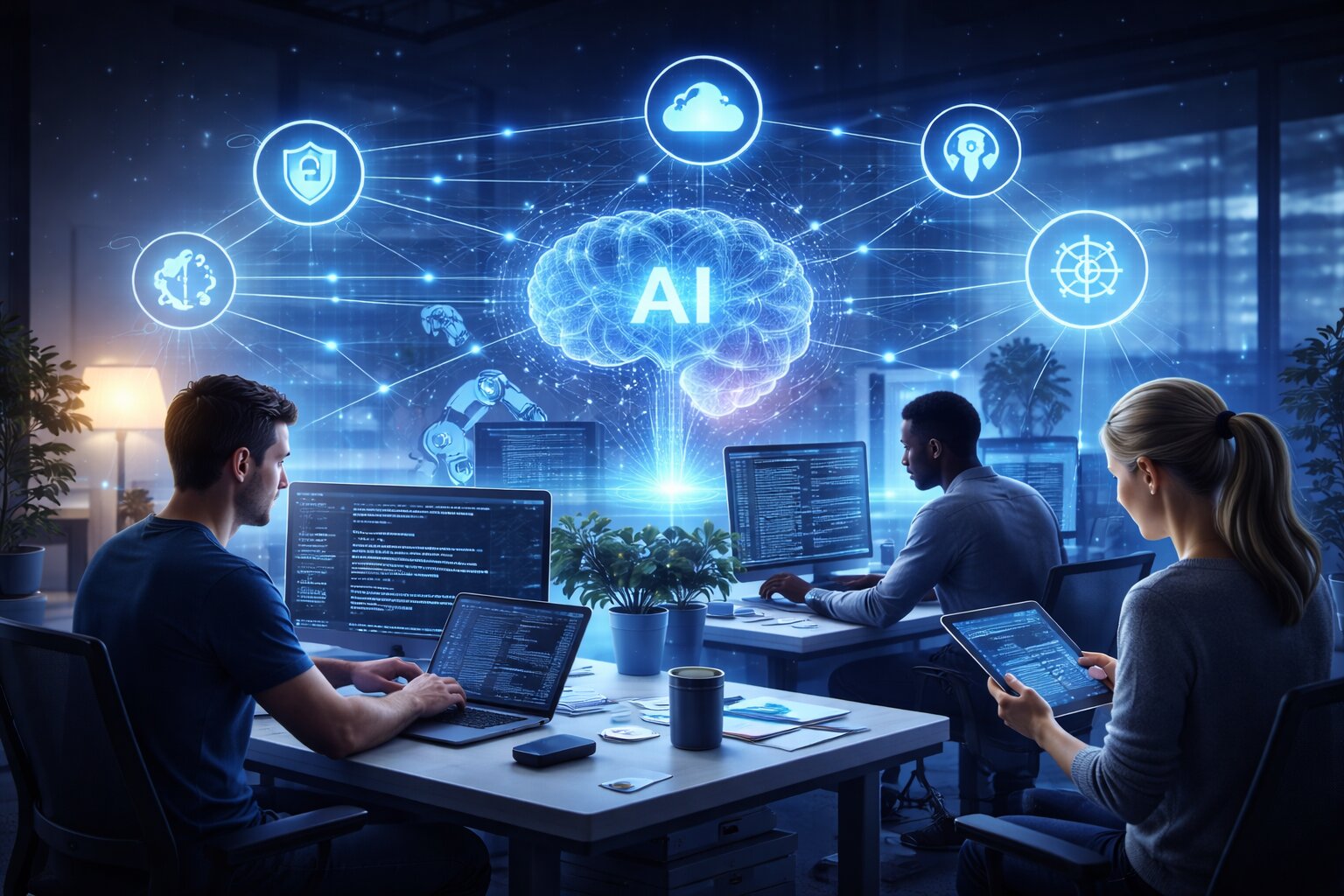
Software Development Trends Defining 2026
Software development is evolving at a rapid pace, shaped by advances in artificial intelligence, changing business needs, and the increasing complexity of digital systems. What was once a discipline focused primarily on writing and maintaining code has expanded into a broader ecosystem involving automation, collaboration, and continuous innovation.
As organisations rely more heavily on software to drive operations and deliver services, the expectations placed on development teams are changing. Speed, scalability, security, and adaptability are no longer optional—they are essential. The trends shaping software development in 2026 reflect these demands, pointing toward a future where development is more intelligent, integrated, and responsive.
The Integration of AI Into Development Workflows
Artificial intelligence is becoming a core component of software development processes. Tools powered by AI are assisting developers in writing code, identifying bugs, and optimising performance.
Code generation systems can suggest or automatically produce code based on natural language prompts or existing patterns. This can significantly reduce development time and allow developers to focus on higher-level design and problem-solving.
AI is also being used in testing and debugging. Machine learning models can identify anomalies in code behaviour, detect vulnerabilities, and predict potential issues before they arise.
Rather than replacing developers, AI is augmenting their capabilities, enabling more efficient and effective workflows.
The Rise of Low-Code and No-Code Platforms
Low-code and no-code platforms are making software development more accessible to a wider audience. These platforms allow users to create applications using visual interfaces and pre-built components, reducing the need for extensive programming knowledge.
This trend is particularly relevant for organisations looking to accelerate development and empower non-technical users to contribute to digital projects.
While these platforms are not suitable for all use cases, they are increasingly being used for internal tools, prototypes, and certain types of business applications.
The rise of low-code and no-code reflects a broader shift toward democratising software development.
SaaS companies are at the forefront of many of these moves, as you can see with the way that the likes of Mollie are using technological advances to push things forwards. In their case, the focus is on the payments industry, but there are many more examples.
Cloud-Native Development and Distributed Systems
Cloud computing continues to be a central pillar of modern software development. Cloud-native approaches, which involve building applications specifically for cloud environments, are becoming the standard.
This includes the use of microservices architectures, where applications are composed of smaller, independent services that can be developed, deployed, and scaled separately.
Containerisation technologies and orchestration tools enable more flexible and efficient deployment, supporting rapid iteration and scalability.
Distributed systems are also becoming more common, allowing applications to operate across multiple locations and environments.
These approaches provide the flexibility and resilience needed to support modern digital services.
DevOps and Continuous Delivery
The integration of development and operations—commonly referred to as DevOps—has become a key practice in modern software development.
DevOps emphasises collaboration, automation, and continuous improvement. Continuous integration and continuous delivery (CI/CD) pipelines allow code changes to be tested and deployed more frequently and reliably.
Automation plays a critical role in this process, reducing manual effort and minimising the risk of errors.
As organisations seek to deliver software more quickly and efficiently, DevOps practices are becoming increasingly important.
Security as a Core Development Principle
Security is no longer an afterthought in software development. With the increasing frequency and sophistication of cyber threats, security must be integrated into every stage of the development lifecycle.
This approach, often referred to as DevSecOps, involves embedding security practices into development and operations processes.
Automated security testing, code analysis, and vulnerability scanning are becoming standard components of development workflows.
By addressing security early and continuously, organisations can reduce risks and improve the overall resilience of their systems.
The Growth of API-Driven Architectures
Application programming interfaces (APIs) are playing a central role in modern software ecosystems. APIs enable different systems and services to communicate and share data, supporting integration and interoperability.
API-driven architectures allow developers to build applications by combining existing services, reducing the need to create everything from scratch.
This approach supports modularity and flexibility, enabling organisations to adapt more quickly to changing requirements.
As digital ecosystems become more interconnected, the importance of APIs continues to grow.
The Shift Toward Developer Experience
Developer experience (DX) is becoming an increasingly important focus. Organisations are recognising that improving the tools, processes, and environments available to developers can enhance productivity and job satisfaction.
This includes providing better documentation, more intuitive tools, and streamlined workflows.
Investing in developer experience can lead to faster development cycles, higher-quality code, and improved collaboration.
As competition for skilled developers increases, creating a positive development environment is becoming a strategic priority.
Edge Computing and Real-Time Applications
Edge computing is emerging as a significant trend, particularly for applications that require low latency and real-time processing.
By processing data closer to where it is generated, edge computing reduces the need to transmit data to centralised cloud servers, improving performance and responsiveness.
This is particularly relevant for applications such as IoT systems, autonomous devices, and real-time analytics.
As the demand for real-time capabilities grows, edge computing is likely to play a larger role in software development.
Sustainability and Efficient Computing
Sustainability is becoming an important consideration in software development. As digital systems consume increasing amounts of energy, there is growing awareness of the environmental impact of software.
Developers are beginning to focus on creating more efficient code, optimising resource usage, and reducing energy consumption.
Cloud providers are also investing in more sustainable infrastructure, supporting efforts to reduce the carbon footprint of digital services.
This trend reflects a broader shift toward more responsible and sustainable technology practices.
Collaboration and Remote Development
The way development teams collaborate is also evolving. Remote and distributed work models have become more common, supported by digital collaboration tools.
Version control systems, cloud-based development environments, and communication platforms enable teams to work together effectively regardless of location.
This shift has implications for how teams are structured and managed, as well as how projects are coordinated.
Collaboration tools and practices are becoming increasingly important in supporting these new ways of working.
The Future of Software Development
The trends shaping software development in 2026 point toward a more intelligent, automated, and interconnected landscape.
Artificial intelligence will continue to play a central role, enabling new levels of efficiency and innovation. Cloud-native approaches, APIs, and distributed systems will support more flexible and scalable applications.
At the same time, considerations such as security, sustainability, and developer experience will remain critical.
As the field continues to evolve, the ability to adapt to new technologies and approaches will be essential for developers and organisations alike.
A Discipline in Transformation
Software development is no longer defined solely by code. It is a dynamic and evolving discipline that encompasses a wide range of tools, practices, and technologies.
The trends emerging in 2026 reflect a shift toward more integrated and intelligent systems, where development is faster, more collaborative, and more aligned with broader organisational goals.
Understanding these trends provides insight into how software is shaping—and being shaped by—the digital world.
Do you have more to add to the debate on the future of software? We would welcome your input and we’re open to informative technology guests posts for those who would like to write for us on all aspects of tech. Get in touch to find out more.