
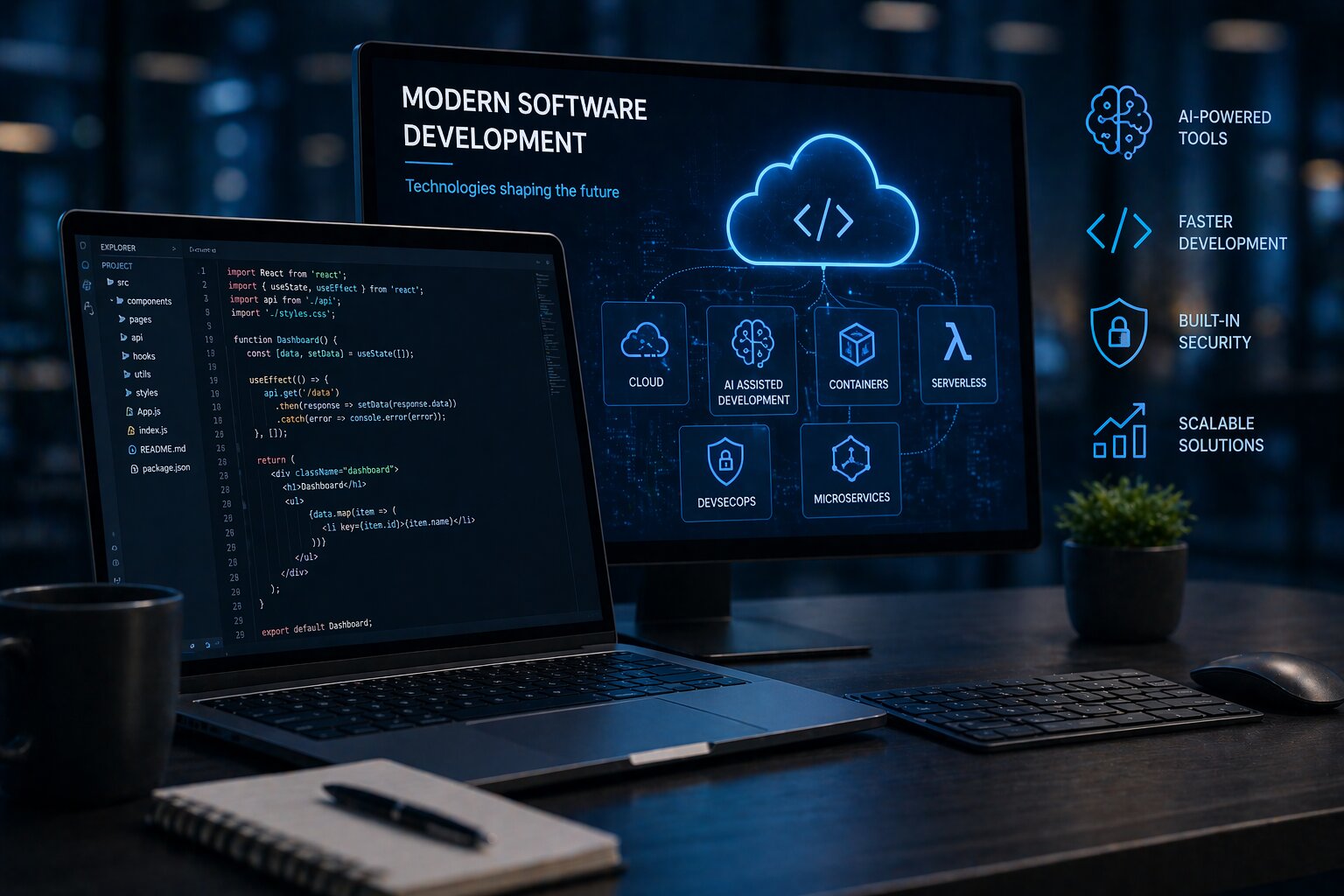
New Software Development Technologies Shaping the Industry
Software development never stands still for long. New languages, frameworks, infrastructure models, and tooling approaches continue to reshape how digital products are built, tested, deployed, and maintained. Some changes are gradual, building over years as teams refine existing practices. Others arrive more quickly, driven by shifts in cloud computing, artificial intelligence, security demands, or the growing need for faster and more scalable digital services.
This constant movement is one of the defining characteristics of the software industry. Developers are not only writing code. They are working inside an environment where the tools, expectations, and underlying platforms are continuously evolving. That makes it increasingly important to understand not just what software does, but how modern software is being created differently from even a few years ago.
New software development technologies matter because they shape the speed of delivery, the quality of applications, the structure of teams, and the long-term resilience of digital systems. They influence whether products can scale efficiently, whether developers can collaborate effectively, and whether organisations can keep pace with changing user expectations.
The shift toward cloud-native development
One of the most significant developments in recent years has been the continued move toward cloud-native software. This term refers to applications that are designed specifically for cloud environments rather than simply being moved into the cloud after traditional development.
Cloud-native systems are typically built to be distributed, scalable, and modular. They take advantage of cloud infrastructure to support rapid deployment, dynamic resource allocation, and flexible service integration. Instead of building software around one fixed server environment, teams increasingly develop applications that can run across multiple instances, scale on demand, and recover more easily from disruption.
This approach changes how developers think about architecture. It encourages the use of smaller, more adaptable services and reduces dependence on tightly coupled systems that are difficult to update. It also aligns with the needs of modern businesses, which often expect software to grow quickly, handle variable traffic, and support global access without major redesign.
Containers and orchestration platforms
Closely related to the cloud-native movement is the growing use of containers and orchestration platforms. Containers allow software and its dependencies to be packaged in a consistent way, making it easier to run applications across different environments without the familiar compatibility issues that once slowed development.
This consistency matters because software often behaves differently depending on where it runs. Development machines, testing environments, and production systems can introduce subtle differences that create problems during deployment. Containers reduce this friction by standardising the runtime environment.
Orchestration platforms take this a step further by managing how containers are deployed, scaled, networked, and maintained across larger systems. As applications become more modular, the ability to coordinate many moving parts becomes essential. These technologies have therefore become central to modern infrastructure strategy, particularly for teams managing large-scale web platforms, APIs, and enterprise systems.
Their impact is not only technical. They also reshape workflows. Developers can build with greater confidence that code will behave consistently, and operations teams can manage infrastructure more efficiently in dynamic cloud environments.
The expansion of serverless computing
Another major technology trend is serverless computing. Despite the name, serverless systems still run on servers, but the underlying infrastructure is abstracted away from the developer. Instead of managing servers directly, developers can focus on writing code that runs in response to specific events or requests.
This model has gained attention because it can reduce operational overhead and make certain applications easier to build and scale. Functions can be triggered by user actions, database changes, file uploads, or API requests, and the cloud platform handles much of the underlying provisioning automatically.
Serverless development is particularly useful for applications with variable demand, event-driven workflows, and modular tasks that do not require a continuously running service. It can also support faster experimentation because teams can deploy discrete units of functionality without building full infrastructure around them.
However, serverless architecture is not a universal solution. It introduces new design considerations around latency, cost management, and observability. Still, it represents a clear example of how software development is moving toward greater abstraction and more flexible infrastructure models.
AI-assisted coding and development tools
Artificial intelligence is also becoming a more visible part of software development itself. AI-assisted coding tools can help generate boilerplate code, suggest completions, assist with debugging, summarise logic, and support documentation. These tools are not replacing developers, but they are influencing how development work is carried out.
Their appeal lies in speed and convenience. Routine tasks that once required repetitive manual effort can now be accelerated with intelligent suggestions. Developers can move more quickly through common patterns and focus more attention on architecture, problem-solving, and review.
At the same time, AI-assisted development introduces new challenges. Generated code still needs to be understood, tested, and validated. Security risks, logical errors, and hidden inefficiencies can still appear. The role of the developer therefore becomes less about typing every line and more about evaluating, refining, and directing the work.
This shift may become one of the most important changes in development culture over the next few years. It reflects a move toward collaboration between human judgment and automated tooling, rather than simple automation alone.
The continued rise of low-code and no-code platforms
Although traditional software development remains central to the industry, low-code and no-code platforms are becoming increasingly important. These tools allow users to build applications, workflows, and internal systems with reduced dependence on manual coding, often through visual interfaces and prebuilt components.
Their rise reflects a growing demand for speed and accessibility. Organisations want to solve business problems quickly, and not every software need requires a fully bespoke application built from scratch. For certain use cases, low-code platforms provide a faster route to deployment, particularly for internal tools, data dashboards, simple automation, and workflow systems.
These platforms do not eliminate the need for developers. Instead, they change where developer effort is best used. Complex systems, performance-sensitive applications, and security-critical environments still require traditional engineering expertise. But low-code tools are widening the range of people who can participate in digital problem-solving.
That makes them a significant technology development, not because they replace software engineering, but because they expand the broader ecosystem in which software is created.
API-first and composable development
Modern software is increasingly built around APIs and composable architectures. Instead of creating every capability from scratch inside one tightly bound system, developers can connect specialised services together through well-defined interfaces.
This API-first mindset changes how products are designed. Authentication, payments, communications, analytics, search, media handling, and mapping can all be integrated through external services rather than rebuilt internally. The result is often faster development and greater flexibility.
Composable development takes this idea further by encouraging systems to be assembled from modular components that can be replaced or updated independently. This supports scalability, easier maintenance, and more targeted improvements over time.
The value of this approach is especially clear in environments where speed matters. Teams can focus on the parts of the product that create unique value, while relying on established services for supporting capabilities. At the same time, this introduces questions around dependency management, vendor lock-in, and architectural complexity. Even so, the trend toward modular, connected software ecosystems is becoming increasingly strong.
Modern front-end frameworks and component-based design
Front-end development has also continued to evolve through more sophisticated frameworks and component-based design systems. Modern interfaces are expected to be responsive, dynamic, and consistent across devices, which has increased the importance of reusable components and structured front-end architecture.
Component-based development allows interfaces to be broken into smaller, maintainable pieces that can be reused across different parts of an application. This improves consistency and makes it easier for teams to scale products without duplicating interface logic unnecessarily.
Alongside this, front-end tooling has matured significantly. Build tools, bundlers, state management libraries, and design system integration now play a central role in how web interfaces are created. The front end is no longer simply a presentation layer. It has become a complex development environment in its own right.
This matters because users increasingly experience software through web-based applications that behave more like full platforms than static pages. The technologies shaping front-end development are therefore central to how software feels and performs in everyday use.
DevSecOps and security-focused development
Security is also becoming more deeply embedded in the development lifecycle. Rather than being treated as something added at the end, security is increasingly integrated into development, deployment, and maintenance processes from the start.
This has led to the growth of DevSecOps, an approach that combines development, operations, and security into a more unified workflow. Automated security scanning, dependency monitoring, infrastructure validation, and policy enforcement are being built directly into development pipelines.
The reason for this shift is straightforward. Modern software environments move quickly, and security risks can emerge at every stage, from code dependencies to misconfigured cloud services. If security is treated as a separate afterthought, vulnerabilities may persist too long or be introduced too easily.
New development technologies are therefore not just about speed or convenience. Increasingly, they are also about creating safer ways to build and deploy digital systems.
Observability and intelligent monitoring
As software systems become more distributed and complex, observability has become an important technology area. Traditional monitoring often focused on whether a server was running or whether an application was down. Modern observability tools go much further by helping teams understand what is happening inside complex, distributed systems in real time.
This includes tracing requests across services, analysing system logs, measuring performance metrics, and identifying patterns that may indicate problems before they become critical. In highly distributed cloud environments, this level of visibility is essential.
Observability technologies support faster debugging, more reliable deployment, and better long-term performance management. They also align with the growing expectation that digital services must be available and responsive at all times. If a modern application serves users continuously across regions and devices, understanding its internal behaviour becomes a major part of development itself.
Edge computing and real-time software
Another emerging area is edge computing, which brings data processing closer to where information is generated rather than relying entirely on centralised cloud infrastructure. This is especially relevant for applications that require low latency, real-time response, or support for large networks of connected devices.
Edge-based software development is becoming more important in areas such as IoT, industrial systems, smart cities, and real-time consumer services. By reducing the distance data must travel, edge technologies can improve speed and resilience.
This changes software architecture in meaningful ways. Developers must think about distributed logic, local processing, synchronisation, and how applications behave across a broader network of environments. It also reflects a wider shift in how digital systems are structured as the world becomes more connected and more dependent on immediate response.
The growing importance of developer experience
Not all new software development technologies are purely technical in the narrow sense. Increasingly, organisations are investing in developer experience, or DX, as a strategic priority. This includes the tooling, documentation, workflows, environments, and internal platforms that make it easier for developers to build and maintain software effectively.
Internal developer platforms, better documentation systems, improved testing frameworks, and more streamlined local environments all contribute to this trend. The logic is simple: when developers can work more efficiently, products can move faster and teams can sustain quality more consistently.
This focus on DX shows that software development technologies are not just about what runs in production. They are also about the environments in which software is created. In an industry where speed, complexity, and competition continue to increase, the development experience itself has become an important area of innovation.
A constantly shifting foundation
The software industry is being shaped by a broad set of new technologies, from cloud-native infrastructure and serverless computing to AI-assisted coding, composable systems, and more security-focused workflows. These technologies do not all serve the same purpose, but together they point toward a development environment that is more distributed, more automated, and more adaptive than before.
What makes these changes significant is not only that they introduce new tools, but that they alter how software is imagined and built. Developers are increasingly working with modular architectures, abstracted infrastructure, intelligent tooling, and systems designed for continuous change.
That means software development is becoming less about isolated coding tasks and more about managing interconnected environments where architecture, automation, and strategic judgment all matter. For anyone trying to understand where the software industry is headed, these new technologies offer a strong indication: the future of development will be shaped not only by what software can do, but by how flexibly and intelligently it can be created.
Do you have anything to add on the latest software trends? Whether you have a particular interest in pushing development forward using AI, or maybe have a firm understanding of testing and prototyping, we’d welcome your input. We have frequent opportunities for guest post collaboration on tech topics and stories of interest.