AI Job Threat Levels Explained
AI job risk is not a simple yes-or-no question. A job is rarely either completely safe or certain to disappear. Most roles sit somewhere between those extremes, with some tasks exposed to automation and others still dependent on human judgement, accountability or physical presence.
That is why “AI job threat levels” are more useful than broad claims about whether artificial intelligence will replace workers. Threat levels help separate jobs that may be lightly assisted by AI from jobs where AI could reduce hiring, restructure teams or replace a large share of routine work.
A job’s threat level depends on what the worker actually does, not just the job title. Two people with the same title can face different levels of risk if one handles repetitive tasks and the other manages complex judgement, clients, strategy or real-world execution.
Why threat levels matter
AI predictions often focus on big numbers. The World Economic Forum has estimated that 92 million jobs may be displaced by 2030, while 170 million new roles may be created, producing a net gain of 78 million jobs. That makes the overall future look mixed rather than purely negative. But those numbers do not tell an individual worker whether their own role is safe.
The IMF has estimated that about 40% of global employment is exposed to AI, rising to around 60% in advanced economies. It also notes that roughly half of exposed jobs may benefit from AI integration, while the other half may face reduced labour demand, lower wages or disappearing tasks.
This is why threat levels are useful. Exposure is not the same as replacement. A job can be exposed because AI helps workers perform better. It can also be exposed because AI performs the core tasks employers used to hire people to do.
For the wider labour-market context, see our overview of AI job loss predictions.
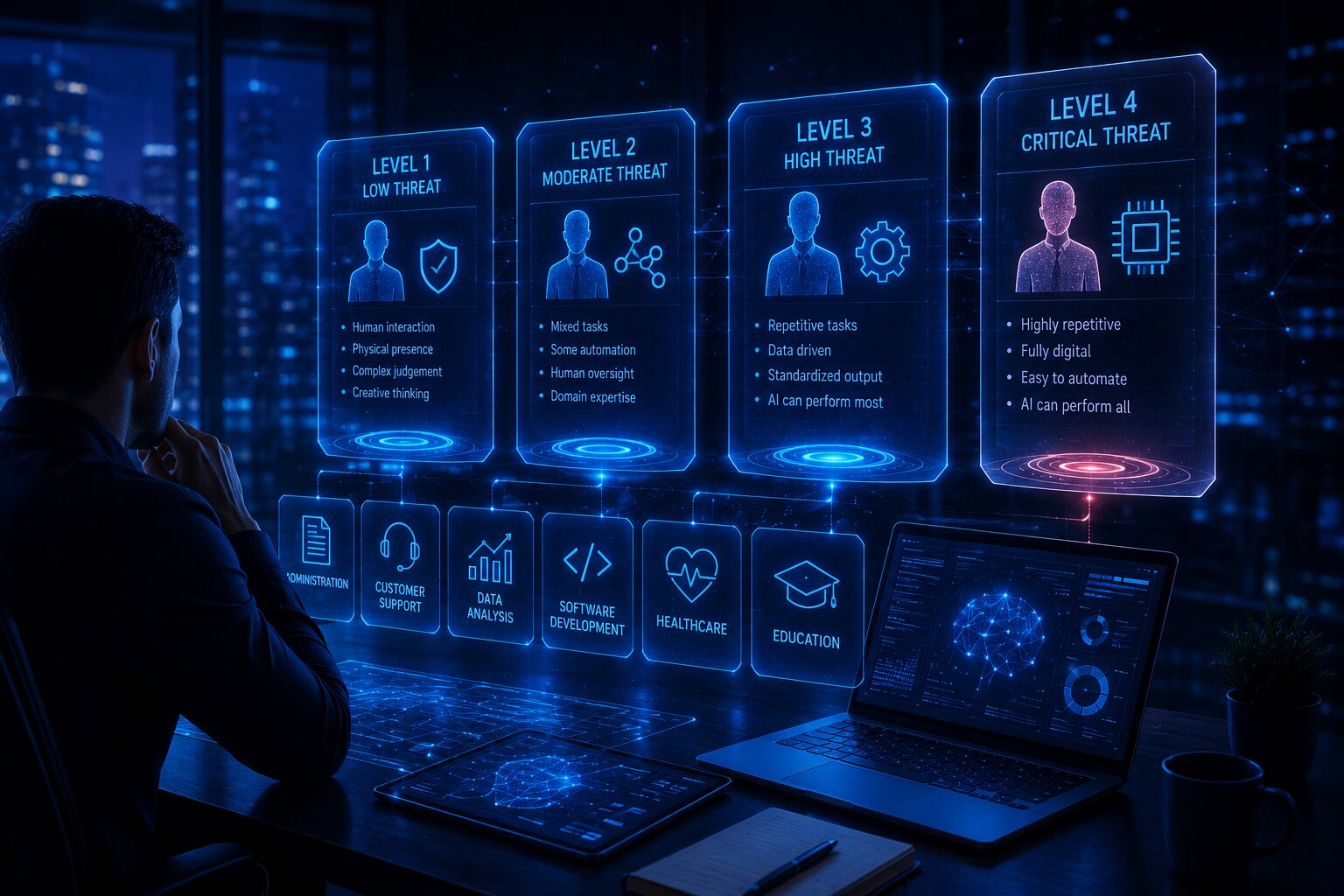
Level 1: Low AI threat
Low-threat jobs are roles where AI may be useful, but not central enough to replace the worker. These jobs usually involve physical presence, real-time judgement, personal trust, manual skill, emotional intelligence or responsibility for outcomes in unpredictable environments.
Examples include many skilled trades, healthcare support roles, emergency services, hands-on engineering, childcare, social care, high-touch hospitality, field maintenance, specialist craft work and many forms of in-person management.
AI may still support these jobs. It can help with scheduling, diagnostics, inventory, training, documentation or customer communication. But the worker remains essential because the work happens in the real world and often involves people, places, materials or safety-critical decisions.
A chef is a useful example. AI can suggest recipes, forecast demand, estimate costs or support menu planning, but it cannot run a busy kitchen, taste consistently, manage service pressure, coordinate a brigade or respond physically to what is happening in the room. That is why the cluster also includes a closer look at why chef jobs may be more resilient to AI.
Low threat does not mean no change. It means AI is more likely to become a supporting tool than a direct substitute.
Level 2: Moderate AI threat
Moderate-threat jobs contain a mix of automatable and non-automatable work. AI can take over some repeatable tasks, but the role still depends on judgement, communication, domain knowledge or accountability.
Many professional roles fall into this category. Teachers, marketers, project managers, designers, consultants, analysts, software engineers, HR professionals, salespeople and accountants may all use AI heavily, but their value does not come only from producing routine output.
For example, a marketer may use AI to draft campaign copy, generate research summaries or test messaging. But strategy, brand judgement, audience understanding and commercial accountability still require human direction. A teacher may use AI for lesson planning, but classroom management, pastoral care and adaptation to students remain human-centred.
Moderate-threat roles are likely to change significantly. The danger is not always redundancy. It may be higher expectations, smaller teams, faster deadlines or fewer junior positions.
This is the category where workers should pay close attention. A role with moderate AI threat can move in either direction. Workers who learn to use AI well may become more productive and valuable. Workers who remain focused only on routine outputs may become easier to replace.
For a practical worker-focused version of this question, see how to assess whether your job is safe from AI.
Level 3: High AI threat
High-threat jobs are roles where a large share of the work is digital, repeatable, rules-based and measurable. These jobs often involve structured information, templates, routine communication, predictable decisions or standardised production.
Examples may include clerical administration, basic data entry, routine customer support, transcription, simple bookkeeping, document processing, first-draft content production, basic research summaries and some junior technical tasks.
The International Labour Organization has argued that generative AI is more likely to augment than destroy jobs overall, but it identifies clerical work as one of the most exposed categories.
High-threat jobs are vulnerable because AI does not need to perform every part of the job. If it can handle the repetitive 60% or 70%, employers may redesign the role around fewer people. A company may not announce that AI has “replaced” a department. It may simply reduce hiring, consolidate teams or raise productivity targets.
McKinsey has estimated that by 2030, activities accounting for up to 30% of current hours worked in the United States and 27% in Europe could be automated, accelerated by generative AI. Its research highlights office support, customer service and food service as areas likely to face pressure.
High-threat does not mean every worker in the field is doomed. It means the job needs active adaptation. Workers should move toward exception handling, client relationships, quality control, process improvement, domain expertise or supervisory responsibility.
Level 4: Critical AI threat
Critical-threat roles are those where the core output can be generated, checked and delivered by AI-supported systems with limited human involvement. These jobs are often narrow, repetitive and easy to measure.
This category may include very basic copy production, simple image generation, low-complexity translation, routine form processing, scripted customer interactions, simple reporting and other work where quality standards are clear and variation is limited.
The risk is highest when three conditions appear together: the work is fully digital, the output is standardised and the employer can tolerate some automation error or add light human review at the end.
A critical-threat job may not disappear immediately. But the economics can change quickly. If one worker using AI can do what three workers previously did, hiring demand falls even if some humans remain in the workflow.
These are the jobs where workers should consider urgent repositioning. That may mean moving into oversight, quality assurance, customer escalation, compliance, specialist knowledge or adjacent work that requires more judgement.
The difference between exposure and replacement
A common mistake is to treat AI exposure as the same thing as job loss. Exposure simply means AI can affect the work. Replacement means the employer can remove or significantly reduce human labour.
A surgeon is exposed to AI through imaging tools, diagnostics and robotics, but that does not make the surgeon easy to replace. A junior document reviewer may be less visible in public debate, but more vulnerable if AI can review, classify and summarise large volumes of material.
The same applies in technology. Software jobs are exposed because AI can generate code, write tests and explain errors. But senior engineers, architects, security specialists and technical leaders still handle systems design, risk, trade-offs and accountability. That is why the question of whether tech jobs are safe from AI is more complicated than many headlines suggest.
Exposure should be treated as a warning signal, not a verdict.
How to score a job’s AI threat level
A practical AI threat assessment starts with five questions.
First, is the work mostly digital? AI is strongest where inputs and outputs already exist as text, code, images, forms, numbers or structured records.
Second, is the work repetitive? Tasks that follow clear patterns are easier to automate than tasks requiring adaptation.
Third, is the output easy to judge? AI is easier to deploy where quality can be measured quickly, such as completed forms, answered tickets, standard reports or simple code.
Fourth, does the role require human trust? Jobs involving care, negotiation, leadership, sensitive decisions or high accountability are harder to automate fully.
Fifth, does the job require physical presence? Work that depends on real-world movement, equipment, materials, kitchens, patients, homes or sites is less exposed to pure software automation.
A job with mostly digital, repetitive, measurable work and little human accountability is high risk. A job with physical presence, judgement, trust and unpredictable conditions is lower risk.
Why entry-level jobs may score higher
Entry-level jobs often contain more routine tasks than senior roles. Junior workers draft documents, prepare notes, clean data, respond to basic queries, test simple features, create first versions and complete administrative work.
Those tasks are valuable because they help people learn. But they are also exactly the kind of tasks AI can absorb. This creates a long-term problem for career progression. Organisations may still need senior people, but fewer junior workers may get the chance to develop into senior roles.
This is one of the reasons AI disruption could feel uneven. The headline number of jobs may not collapse, but the first rung of some career ladders may become narrower.
The cluster article on which jobs AI may replace by 2030 will look more closely at roles where this pressure may arrive fastest.
Threat levels can change
AI job threat levels are not fixed. They change as technology improves, regulation develops, customers adapt and employers redesign workflows.
A role that looks safe today may become more exposed if AI gains stronger reasoning, better reliability or better integration with business systems. A role that looks vulnerable may become more secure if regulation, liability or customer expectations require human oversight.
Workers can also change their own threat level. Learning AI tools, building domain expertise, handling exceptions, managing people, improving communication and taking responsibility for outcomes all make a role harder to replace.
For writers, technologists and workplace specialists with direct experience of this shift, Dykes Do Digital is open to outside perspectives. You can submit a guest article to Dykes Do Digital on AI, automation or the future of work.
A useful framework, not a perfect forecast
AI job threat levels should not be treated as a perfect prediction system. They are a way to think more clearly about risk.
Low-threat jobs are likely to use AI as support. Moderate-threat jobs will be redesigned. High-threat jobs may face reduced hiring and restructuring. Critical-threat jobs may see large parts of the role automated or absorbed into AI-supported workflows.
The most important question is not whether AI can perform one task in your job. It is whether AI can perform enough of the valuable work for an employer to change how many people it needs.
That is where the real threat lies. Not in a sudden replacement of every worker, but in a gradual redesign of work around smaller teams, faster output and fewer routine roles.