Software Development Industry Statistics: What the Numbers Reveal About Modern Tech
The software development industry has grown into one of the most influential sectors in the global economy. From cloud computing platforms and mobile applications to artificial intelligence systems and enterprise infrastructure, software underpins nearly every modern industry. While individual tools and technologies often capture attention, it is the broader statistical picture that reveals how the industry is evolving, where investment is flowing, and how digital transformation is reshaping business and society.
Understanding software development through statistics provides a clearer view of scale, direction, and change. It highlights not only how large the industry has become, but also how quickly it continues to expand, adapt, and redefine itself.
The scale of the global software industry
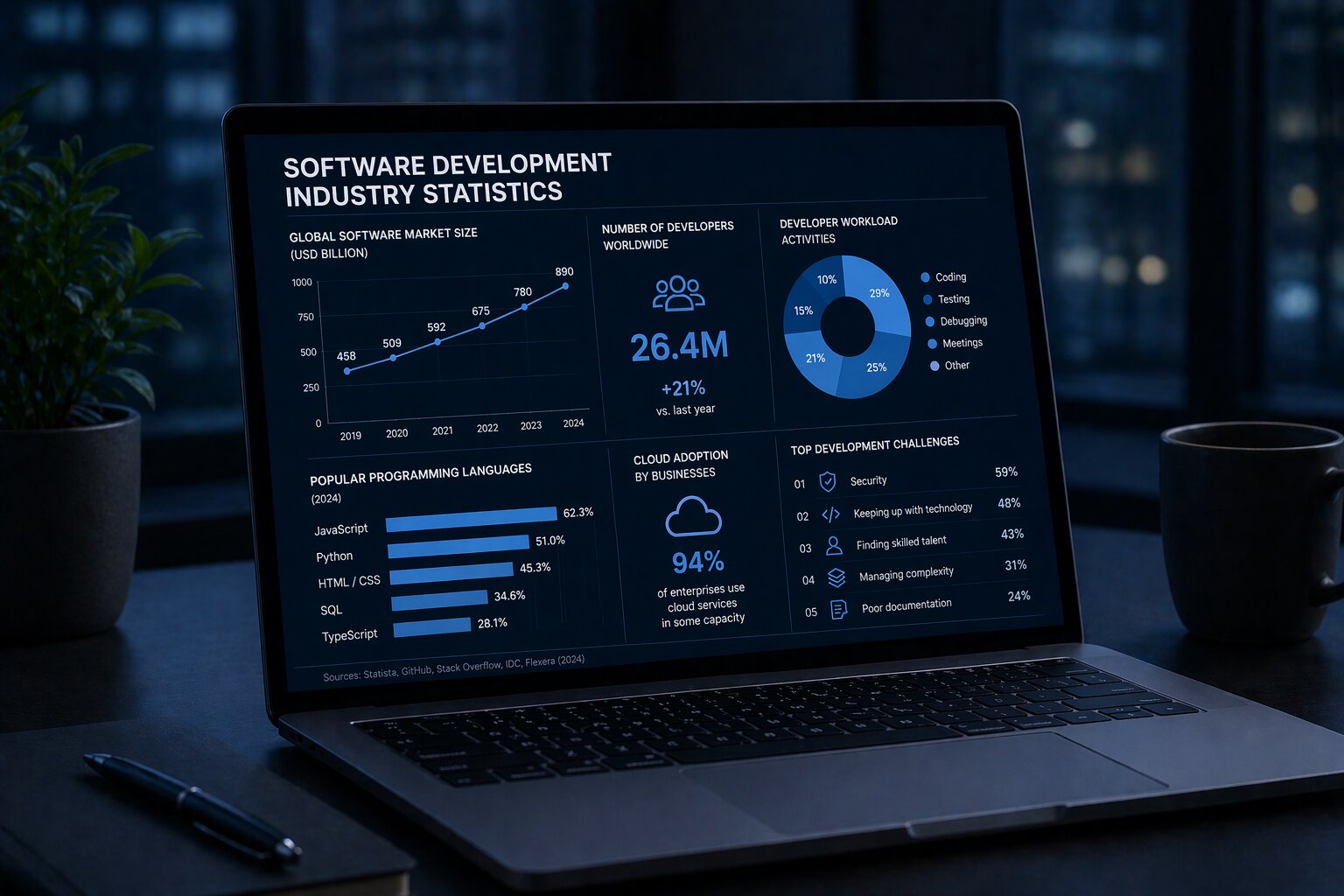
The global software market has expanded rapidly over the past decade, driven by the increasing digitisation of services, the growth of cloud infrastructure, and the widespread adoption of connected technologies. Software is no longer confined to specialist sectors. It now supports finance, healthcare, education, logistics, entertainment, manufacturing, and government systems.
One of the most consistent trends reflected in industry data is sustained growth. Software spending continues to rise year after year, with organisations allocating significant budgets to digital systems, platforms, and development initiatives. This growth is not limited to large enterprises. Small and medium-sized businesses are also investing in software to improve efficiency, reach customers, and remain competitive.
Cloud-based software has played a major role in this expansion. The shift from traditional on-premise systems to cloud-hosted platforms has made software more accessible, scalable, and flexible. As a result, businesses can adopt new tools more quickly and adapt their infrastructure with less friction.
The rise of software developers worldwide
Another key indicator of industry growth is the increasing number of software developers globally. The demand for development skills has risen alongside the expansion of digital services. Organisations across sectors require developers to build, maintain, and improve their systems.
Estimates suggest that tens of millions of developers are now active worldwide, with numbers continuing to grow each year. This reflects both the professional workforce and the broader community of individuals contributing to open-source projects, independent applications, and emerging platforms.
The geographic distribution of developers is also evolving. While traditional technology hubs remain influential, development talent is increasingly distributed across regions. Remote work, global collaboration tools, and online learning platforms have made it easier for developers to participate in international projects regardless of location.
This shift is changing how software teams are structured. Distributed development, remote collaboration, and asynchronous workflows are becoming more common, reflecting a more globalised industry.
The dominance of web and mobile development
Statistics consistently show that web and mobile development remain at the centre of software activity. The web continues to be one of the most widely used platforms for delivering services, while mobile applications have become a primary interface for users.
Web development is particularly significant because of its accessibility. Web applications can be accessed across devices without requiring installation, making them an efficient way to reach large audiences. Advances in browser capabilities have also allowed web applications to become more powerful, supporting complex functionality that was once limited to desktop software.
Mobile development, meanwhile, reflects the widespread use of smartphones. Many services are now designed primarily for mobile users, with applications providing real-time access to communication, commerce, media, and productivity tools.
Together, these areas highlight how software development is closely aligned with user behaviour. The platforms people use most frequently tend to drive where development effort is concentrated.
Programming languages and technology trends
Industry statistics also reveal patterns in the tools and technologies developers use. Certain programming languages and frameworks consistently appear at the top of surveys and usage reports, reflecting their versatility, community support, and relevance to modern applications.
Languages associated with web development, such as those used for front-end and back-end systems, remain widely adopted. At the same time, languages used in data analysis, machine learning, and system-level programming continue to grow in importance as new types of applications emerge.
Frameworks and libraries also play a significant role. Many developers rely on established ecosystems that provide reusable components, development tools, and community support. These frameworks help accelerate development and improve consistency across projects.
One notable trend is the increasing abstraction of complexity. Developers are often able to build sophisticated applications without needing to manage every low-level detail. This is supported by frameworks, cloud services, and development platforms that handle infrastructure, deployment, and scaling.
The impact of cloud computing
Cloud computing has become one of the most significant forces shaping software development. Statistics consistently show strong growth in cloud adoption, with organisations moving infrastructure, applications, and data to cloud environments.
This shift has changed how software is built and deployed. Instead of developing applications for fixed environments, developers increasingly design systems that can scale dynamically, handle distributed workloads, and integrate with multiple services.
Cloud platforms also enable faster development cycles. Continuous integration and continuous deployment practices allow teams to release updates more frequently, respond to feedback quickly, and maintain more flexible development processes.
The rise of cloud-native development has influenced architecture as well. Microservices, containerisation, and serverless computing are becoming more common, reflecting a move toward modular, scalable systems.
Open-source contribution and collaboration
Another important aspect of the software industry is the role of open-source development. Statistics show that a large proportion of developers contribute to or rely on open-source projects. These projects provide shared tools, libraries, and frameworks that form the foundation of many modern applications.
Open-source collaboration has reshaped how software is created. Developers can build on existing work, contribute improvements, and collaborate across organisational boundaries. This has accelerated innovation and reduced duplication of effort.
It has also changed the way organisations approach development. Many companies now actively contribute to open-source projects, recognising the value of shared ecosystems and community-driven improvement.
The growth of AI-assisted development
Recent data indicates a growing interest in AI-assisted development tools. These tools aim to support developers by generating code suggestions, automating repetitive tasks, and helping with debugging and documentation.
While the long-term impact of these tools is still developing, early adoption suggests that they may influence how software is written and reviewed. They have the potential to increase productivity, particularly for routine tasks, while allowing developers to focus more on design and problem-solving.
However, statistics also highlight ongoing questions about reliability, security, and the role of human oversight. AI tools can assist development, but they do not replace the need for understanding, testing, and critical evaluation.
Security as a growing priority
Security has become an increasingly prominent focus within software development. Industry data shows rising investment in secure development practices, driven by the growing frequency and impact of cyber threats.
Developers are now expected to consider security throughout the development lifecycle, rather than treating it as a separate stage. This includes practices such as secure coding, vulnerability scanning, dependency management, and regular updates.
The concept of “shift-left” security, where security considerations are integrated early in the development process, reflects this trend. It recognises that addressing vulnerabilities early is more effective than reacting to issues after deployment.
The changing nature of development teams
Statistics also reveal changes in how development teams operate. Agile methodologies, iterative development, and cross-functional collaboration have become widely adopted. Teams are often structured to include developers, designers, product managers, and other roles working together throughout the development process.
This approach reflects a shift away from rigid, sequential development models toward more flexible and responsive workflows. It allows teams to adapt to changing requirements, incorporate user feedback, and deliver incremental improvements.
Remote work has further influenced team dynamics. Many development teams now operate across different locations and time zones, relying on collaboration tools and communication platforms to coordinate work.
Education and entry into the industry
The growth of the software industry has also influenced education and career pathways. Statistics show increasing participation in coding education, online courses, and bootcamps, alongside traditional computer science degrees.
This diversity of entry points reflects the demand for skills and the accessibility of learning resources. Many developers now enter the field through self-directed learning, supported by online platforms, tutorials, and community resources.
At the same time, the industry continues to value practical experience, problem-solving ability, and adaptability. The ability to learn and apply new technologies is often as important as knowledge of specific tools.
What the numbers suggest about the future
Taken together, software development industry statistics point to a sector that is both mature and rapidly evolving. The scale of the industry is vast, yet it continues to expand. The tools and platforms developers use are becoming more powerful, yet the need for skilled human judgment remains central.
Several trends stand out. The continued growth of cloud computing suggests that software will become even more distributed and scalable. The rise of AI-assisted tools indicates changes in how developers work. The emphasis on security reflects the increasing importance of protecting digital systems. And the globalisation of development highlights the collaborative nature of modern software creation.
These trends suggest that software development will remain a central part of the digital economy. As more industries rely on software, the demand for development skills, tools, and infrastructure is likely to continue.
A data-driven view of a transforming industry
Software development is often discussed in terms of innovation and new technologies, but statistics provide a different kind of insight. They show how the industry is growing, how it is structured, and how it is changing over time.
By looking at the numbers, it becomes clear that software development is not just a technical activity. It is a global, collaborative, and continuously evolving field that shapes how digital systems are built and used.
For readers seeking to understand the modern technology landscape, industry statistics offer a valuable perspective. They reveal not only where the industry stands today, but also the direction in which it is moving.