How Personal Computing Changed the Way People Organised Digital Life
The story of technology is often told through major inventions, market milestones, and category shifts. We hear about the internet, the smartphone, social media, artificial intelligence, and cloud computing as if each one arrived fully formed and immediately transformed modern life. Yet some of the most important changes in digital history happened more gradually. Personal computing is one of the clearest examples. Its significance lies not only in the machines themselves, but in the way those machines changed how people organised information, communication, work, memory, and routine.
Before personal computing became part of ordinary life, much of human organisation remained fragmented across physical systems. Documents lived in drawers and folders. Calendars sat on desks or kitchen walls. Address books, receipts, letters, notes, financial records, photographs, and music collections all existed in separate formats, governed by different habits and physical limitations. The rise of personal computing began to pull those systems into a single digital environment. That shift did more than improve efficiency. It changed how people thought about information itself.
Today, it is easy to take for granted the idea that digital life should be searchable, portable, synchronised, and infinitely rearrangeable. But those expectations had to be learned. Personal computing played a central role in that learning process. It introduced millions of people to the idea that their information could exist in structured digital systems—systems that could be edited, copied, searched, archived, backed up, moved, and reshaped over time. In doing so, it redefined not only productivity, but the everyday architecture of modern life.
From physical organisation to digital structure
For much of the twentieth century, the organisation of daily life depended on physical objects. Paper records had to be filed manually. A misplaced letter could disappear for years. Telephone numbers were written down in notebooks. Household accounts were tracked through ledgers, statements, and envelopes. Family photographs were stored in albums and boxes. Music collections occupied shelves and cabinets. Information had weight, took space, and often demanded deliberate maintenance.
The rise of personal computing introduced a radically different model. Information no longer needed to be tied permanently to a single physical form. A document could be drafted, revised, duplicated, and saved without producing stacks of paper. A contact list could be updated instantly. A calendar could be changed without crossing out lines on a printed page. Over time, people became accustomed to thinking about their lives in terms of files, folders, software tools, and searchable systems rather than static objects.
This transformation was subtle but profound. It was not only that computers made individual tasks faster. They changed the logic of organisation. Physical systems are often constrained by permanence and scarcity. Digital systems, by contrast, introduced flexibility and repeatability. A file could exist in multiple versions. A piece of information could belong to more than one category conceptually. Storage could scale in ways that physical cabinets could not. These changes affected not just office work, but how ordinary people managed everyday life.
The desktop as a training ground for digital habits
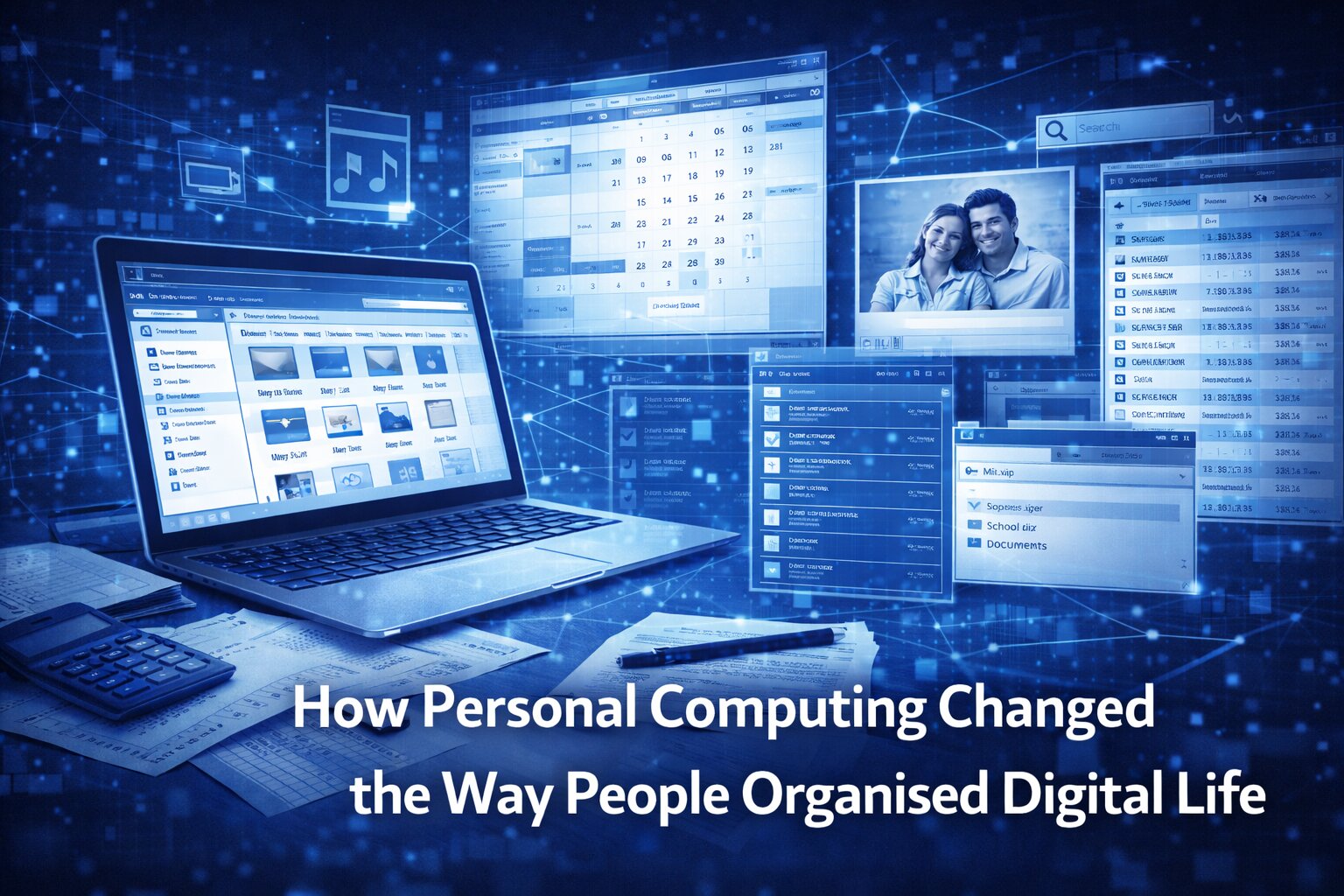
One of the most important roles of personal computing was that it gave users a visual and practical framework for interacting with digital information. The desktop metaphor, particularly in mainstream home and office environments, became a training ground for software literacy. Windows, icons, menus, folders, and documents helped people build an intuitive understanding of how digital structure worked.
That mattered because the desktop made abstract systems feel tangible. Users could drag files, rename them, sort them, create folders, and reopen saved documents. They could print something, edit it, duplicate it, or move it elsewhere. These were not purely technical actions. They were habits of thought. They taught users to see information as something that could be managed, manipulated, and arranged deliberately.
This environment also created continuity between different parts of digital life. Writing a letter, saving a budget spreadsheet, organising photographs, and storing downloaded music all became variations on a shared organisational model. The computer was no longer just a machine for specialist tasks. It became an environment where diverse parts of life could be brought together and managed through common software patterns.
Over time, these habits became so normal that they disappeared into the background. But their impact remains visible in how people still expect digital systems to behave, even in today’s mobile and cloud-based era.
Files, folders, and the architecture of control
If one concept sits at the centre of personal computing’s organisational revolution, it is the file. Files gave people a way to understand digital information as something discrete, movable, and persistent. A letter, spreadsheet, image, or song was not just content on a screen. It was an object within a larger system. It had a name, a location, and a relationship to other files.
Folders extended that logic. They allowed users to create hierarchy, group related items, and impose personal structure on otherwise chaotic collections of information. This changed how people thought about order. Organisation became something users could actively design for themselves rather than something imposed only by physical constraints.
The file-and-folder model was powerful because it combined familiarity with flexibility. It echoed physical filing systems while also enabling new kinds of digital behaviour. Files could be copied without being lost. Folders could be reorganised without physically moving shelves or boxes. Searching could supplement browsing. A system could be deeply personal while still remaining legible.
Although modern apps often hide or abstract file structures, the influence of this model remains strong. Cloud storage, project management tools, note apps, and content platforms all inherit something from the earlier logic of named items, grouped structures, and persistent retrieval. Personal computing made that architecture mainstream.
Writing, editing, and the redefinition of knowledge work
Word processing is often treated as one of the most obvious functions of personal computing, but its cultural importance is difficult to overstate. Before word processors became widely available, editing written work was slower, more linear, and often more physical. Typewritten documents could be difficult to revise cleanly. Drafting involved friction. Reworking structure or tone required effort that influenced how people wrote in the first place.
Personal computing changed this completely. The ability to edit text fluidly transformed writing from a more finalised process into a more iterative one. Users could draft quickly, revise heavily, save versions, and refine documents without starting from scratch. That encouraged a different relationship to language and planning. Writing became less constrained by mechanical limitations and more open to experimentation.
This had organisational consequences beyond writing itself. Reports, letters, forms, meeting notes, school assignments, and personal records all became easier to create and maintain. Written information could now be stored, duplicated, shared, and archived digitally. Over time, this contributed to a huge expansion in how much written material individuals and organisations generated.
In effect, personal computing did not just improve writing. It helped make text central to digital life. Documents became part of a wider information system that linked communication, memory, planning, and administration together.
Spreadsheets and the quantification of everyday decision-making
If word processors reshaped writing, spreadsheets reshaped how people worked with numbers, comparison, and planning. They took an activity that once required paper tables, calculators, and repeated manual effort and made it dynamic, editable, and scalable. For businesses, this was transformative. But the effect reached beyond formal finance or accounting.
Spreadsheets introduced ordinary users to a new way of thinking about organisation: data as something that could be structured, recalculated, and modelled. Household budgets, travel plans, contact lists, inventory tracking, school records, and project timelines could all be managed in a grid-based format that encouraged analysis and adjustment.
This had a lasting effect on digital reasoning. People became more comfortable with the idea that information could be entered into a system and then manipulated through logic. Totals could change instantly. Scenarios could be compared. Patterns could be revealed through formula and structure. This was not merely about productivity software. It was part of a broader shift in how people conceptualised planning and control.
Many contemporary dashboards, analytics tools, and data-driven products still rely on habits formed during this era. The spreadsheet did not just organise numbers. It helped normalise a data-oriented way of approaching everyday problems.
Calendars, contacts, and the digitisation of routine
Another major effect of personal computing was the digitisation of routine life. Calendars, address books, reminders, lists, and schedules all began to migrate into software environments. This may sound less dramatic than innovations in communications or media, but it was vital in shaping how digital organisation became embedded in ordinary behaviour.
A digital calendar does more than store dates. It allows appointments to be moved, repeated, categorised, colour-coded, and linked with other information. A contact manager does more than save names and numbers. It creates a searchable network of relationships and details that can be updated continuously. To-do lists, reminders, and note systems all added to this wider ecosystem of self-management.
Personal computing therefore expanded beyond “work” in the narrow sense. It became part of domestic planning, social coordination, educational life, and personal administration. The computer was increasingly not just where professional tasks were completed, but where life itself was arranged.
This shift helped create the expectation that digital systems should support continuity across multiple domains. Work and home, personal and professional, memory and scheduling all began to coexist inside a shared computational environment. That blending remains a defining feature of contemporary digital life.
Communication software and the restructuring of social time
Email, messaging tools, and early online communication systems added another crucial layer to the organisational role of personal computing. These tools changed not only how messages were delivered, but how social and professional time was structured. Communication could now be asynchronous, archived, searchable, and distributed across expanding networks.
Email in particular had a major organisational impact. Messages became part of a system that included inboxes, folders, drafts, attachments, sent records, and searchable history. This meant communication itself became an object of management. Users did not simply send and receive messages; they organised correspondence, stored records, and built routines around retrieval and response.
That changed expectations around accountability, planning, and responsiveness. Communication became easier to document and revisit. It also became easier to accumulate. This had both positive and negative effects. On one hand, digital communication increased flexibility and reach. On the other, it created new burdens of volume, fragmentation, and constant availability.
Still, its influence on digital organisation was enormous. Communication was no longer ephemeral in the same way as phone calls or casual conversation. It became part of the stored architecture of daily life, embedded in the wider systems people used to manage everything else.
Personal media and the consolidation of memory
Personal computing also transformed how people stored and organised media. Photographs, music, downloaded files, videos, and scanned documents gradually moved into digital collections. This changed not only access, but memory itself.
A family photo album had once been a physical object, limited by space and often organised loosely. A digital photo archive could be vast, searchable, duplicated, and increasingly tagged or sorted by date and event. Music collections moved from shelves and cases into file libraries and media software. Video clips, recorded audio, and personal documents all joined this expanding digital archive.
This mattered because computing became a memory infrastructure. The computer was no longer just a tool for active tasks; it became a place where the record of life accumulated. Users were learning to trust machines not only for calculation or writing, but for preservation and retrieval.
That trust helped prepare the way for later shifts into smartphones, cloud storage, and networked personal archives. The habits of storing life digitally began in the personal computing era and remain central to modern digital culture.
Search as an organisational expectation
One of the most powerful habits personal computing introduced was the expectation that information should be retrievable quickly. As digital archives expanded, search became essential. A file, message, song, image, or contact no longer needed to be remembered only by location. It could be found through query.
This changed the psychology of organisation. Users still valued folders and structure, but they also learned that retrieval could be flexible. A good digital system was not only one that stored information, but one that made that information recoverable when needed. This expectation now underpins almost every meaningful software product.
Search helped digital organisation scale. Without it, large personal archives would have become overwhelming. With it, they became more manageable and more useful. Search also reinforced the idea that software should serve the user’s intention quickly, rather than simply mirror static storage systems.
Modern platforms often treat search as an obvious baseline feature, but its cultural power was built gradually through the experience of personal computing and expanding personal archives.
The tension between order and overload
For all its benefits, personal computing also introduced new kinds of disorder. As it became easier to create, save, copy, and store information, users often found themselves managing growing amounts of digital clutter. Desktops filled up. Downloads accumulated. Email inboxes expanded uncontrollably. Folders multiplied. Versions became difficult to track.
This tension is important because it reveals a central truth about digital organisation: technology does not eliminate complexity. It often shifts and reconfigures it. Personal computing gave users greater control, but also greater responsibility. To stay organised required naming conventions, storage habits, backup awareness, and deliberate maintenance.
This was one of the defining contradictions of the era. Digital systems promised order, but they could also produce new forms of chaos. That remains true today. Cloud services, productivity apps, and AI-enhanced tools still wrestle with the same basic challenge: how to make growing quantities of information feel usable rather than overwhelming.
The personal computing era therefore did not solve organisation once and for all. It introduced a new landscape in which organisation became an ongoing, active practice.
Why this history still matters
Looking back at how personal computing changed the organisation of digital life matters because the effects are still everywhere. Many of the expectations now built into contemporary software—searchability, persistence, editable structure, synchronisation, categorisation, and personal control—were learned through years of interaction with personal computers.
This history also helps explain current debates around software design. Questions about cloud dependence, local control, file visibility, digital overload, platform lock-in, and information management all have roots in earlier computing habits. Understanding those roots gives us a clearer way to interpret the present.
For Dykes Do Digital, this kind of historical perspective matters because it connects today’s technologies to longer trajectories of human adaptation. Digital life did not emerge all at once through social platforms or smartphones. It was built layer by layer, habit by habit, through the structures personal computing introduced and normalised.
The long legacy of personal computing
Personal computing changed more than workflow. It changed how people organised the basic materials of life: writing, numbers, plans, communication, memories, media, and records. It pulled previously separate systems into shared digital environments and taught users to think in terms of files, folders, search, structured storage, and editable continuity.
In doing so, it created the organisational assumptions that still shape modern software. Today’s cloud tools, apps, and AI-enhanced platforms may look very different from the computers of earlier decades, but much of their conceptual foundation was laid in that period. Personal computing made digital organisation ordinary. It taught millions of people how to build, maintain, search, and trust a digital record of their lives.
That legacy is easy to overlook because it now feels normal. But that normality is itself the achievement. Personal computing did not just make information electronic. It redefined how people live with information at all.